Autopsy Nº 07·Chile
Cruz Verde - Monday is not a treatment
Cruz Verde is the largest pharmacy network in Chile and somebody else owns the desire in the category. Someone who takes medication every month is not buying boxes: they are paying a fixed bill, and that bill changes depending on the day of the week.
- BRAND ANALYZED:
- Farmacias Cruz Verde
- Industry
- Pharmacies
- Country
- Chile
- Published
- November 17, 2026
In five lines
Cruz Verde does not have a usage problem: more than 890 stores and around 498,000 monthly searches for its name in Chile. It has a desire problem: in the Cadem survey, Dr. Simi takes 46% of preference and Cruz Verde 20%. People buy the Dr. Simi plush toy; nobody buys their pharmacy's out of obligation. The mistake is not what it does, it is the question that organises it: how to be closer and cheaper than the one next door. Proximity and price are now conditions of entry, not differences. The question that changes the decision is a different one: what would make someone who takes medication every month never think again about where or when to buy it. The proposal, Tratamiento a Cargo, takes the day of the week out of the price and takes charge of the refill. It is tested over 90 days with two price arms and a stop condition on day 60.
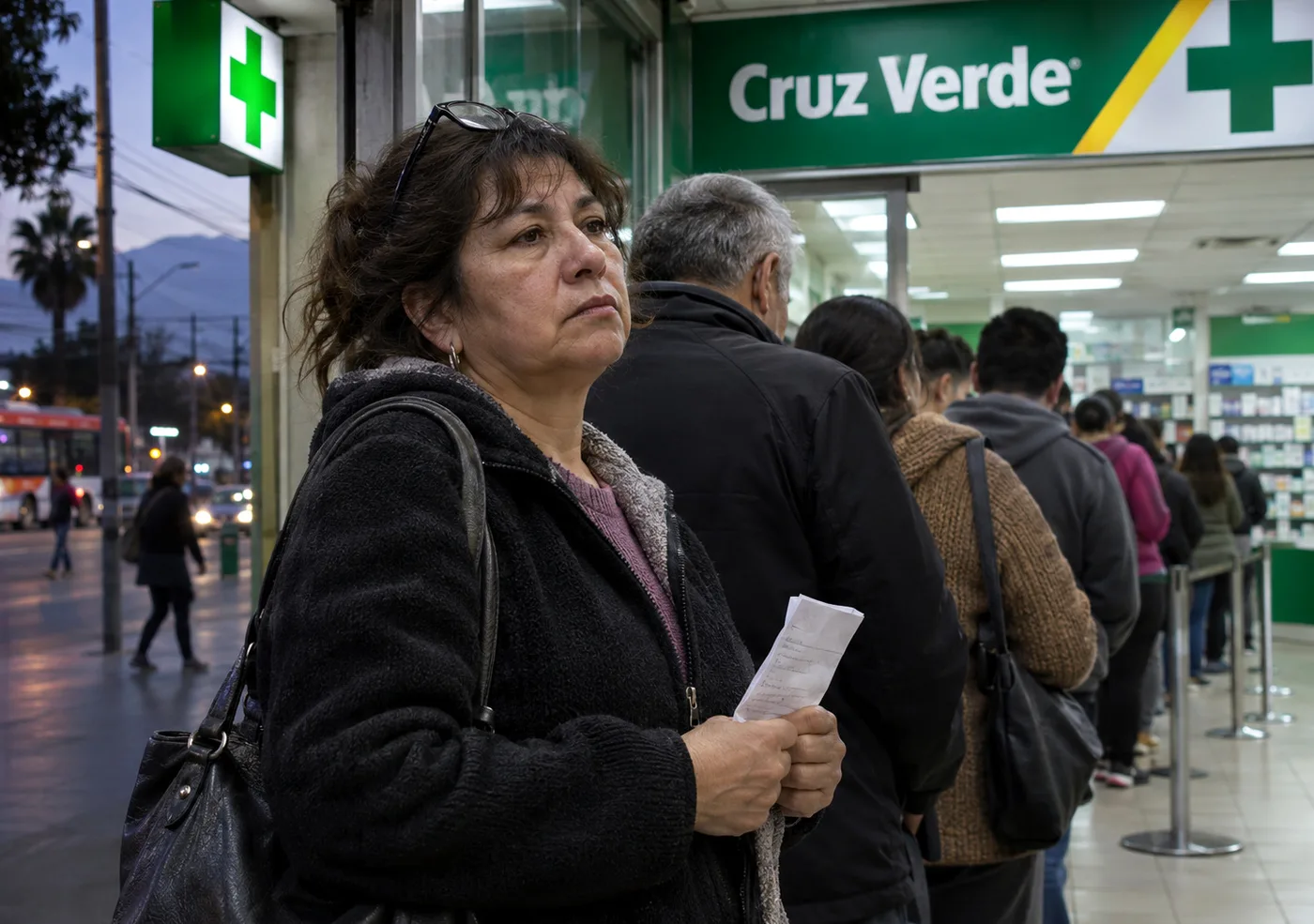
Conceptual cover: the Monday queue. Recreation generated with AI.
Scope and method
- Brand analysed: Farmacias Cruz Verde, operated by FEMSA Salud.
- Market: Chile, pharmacy retail.
- Evidence cut-off date: 17 November 2026.
- Mode: public. Independent analysis using public sources.
- Version: 1.0, prepared by Ariel Pfeffer.
Public mode. An independent reading of Farmacias Cruz Verde in Chile, operated by FEMSA Salud, with public sources consulted up to 17 November 2026. FEMSA Salud also operates in Colombia, Ecuador and Mexico [1]; those markets are out of scope unless expressly mentioned. There was no access to internal data: margins, purchase frequency and retention appear as declared assumptions. The scenes are hypothetical and the names fictitious. The proposal does not exist at Cruz Verde today and nobody commissioned it.
Visual note · The photographs in this edition are conceptual recreations generated with AI. They do not document real situations or services currently offered by Cruz Verde.
Someone who takes medication every month is not buying boxes: they are paying a fixed bill. And nobody desires a bill that changes depending on the day of the week.
01 The uncomfortable truth
The starting hypothesis was that the pharmacy is a category one hundred per cent tolerated and zero per cent desired. The evidence half confirms it.
In August 2025, Cadem asked Chileans which was their preferred pharmacy. Dr. Simi got 46%. Cruz Verde, 20%. Salcobrand, 10% [2]. In October 2026, a Criteria study placed Dr. Simi first in peace of mind and second in trust among the country's brands [3]. Its plush toys cost around CLP 10,000 in Chile and have already reached the stages of well-known artists [4]. Nobody buys their pharmacy's plush toy out of obligation.
In this category desire exists. Somebody else has it.
Cruz Verde, meanwhile, is the largest network in the country: more than 890 pharmacies, according to the general manager of FEMSA Salud Chile [5]. Third-party tools estimate around 498,000 monthly searches for the term “cruz verde” in Chile [6], although a good share must come from someone who needs a medicine and is looking for the nearest open store. It ranks among the five preferred brands in dunnhumby's health and wellbeing index [7] and 37th in the Merco 2025 ranking [8]. It is not a rejected brand. It is a used brand: people choose it because it is close by, not because they want it close by.
There is also a memory the customer keeps even when nobody mentions it. In 2012 the Supreme Court upheld the fine against Cruz Verde and Salcobrand for colluding on medicine prices [9]; the compensation settlement in the class action filed in 2013 was only approved in August 2025 [10]. And the Club Cruz Verde offers 20% off medicines and vitamins on Mondays and Thursdays [11], with additional discounts co-funded by banks [12]. The implicit lesson for anyone shopping on a Tuesday fits in one line: today you overpaid.
02 The invisible mistake
The industry answers a narrow question with a great deal of competition: how to be closer and cheaper than the one next door.
Proximity is measured in stores. Daniel Belaúnde, general manager of FEMSA Salud, said it bluntly to Diario Financiero: if the competition opens three, they open three [13]. The race filled the city with crosses. The Santiago Metropolitan Region went from 1,144 to 2,772 pharmacies between 2023 and 2026, according to GPS Property [14]. Nationwide, Xbrein counted 5,933 operating pharmacies, 260 fewer than in March 2025, with openings slowing and fierce price competition [15]. Proximity is already shared out.
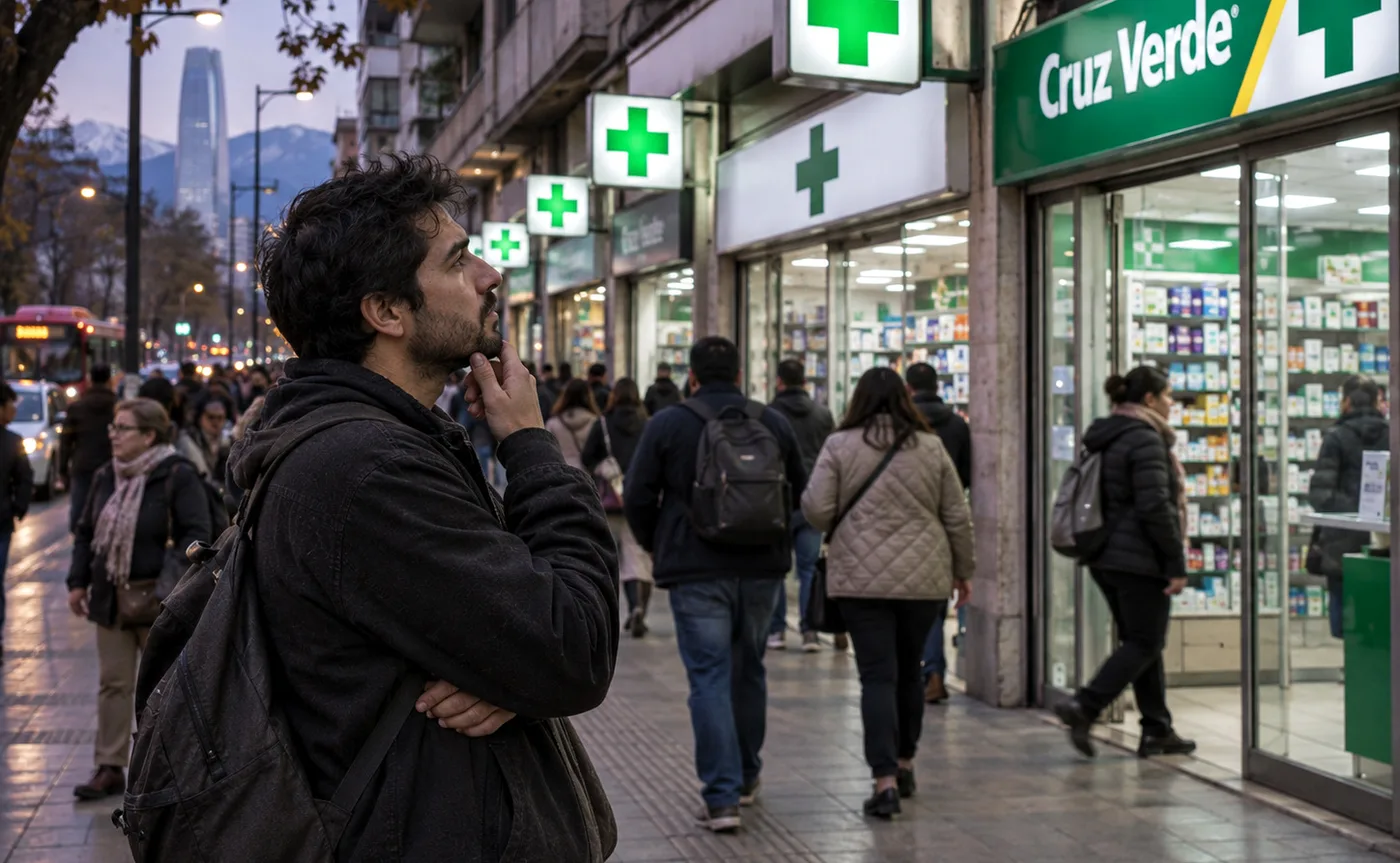
Proximity is already shared out: a street full of crosses. Conceptual recreation generated with AI.
Price also has owners. Dr. Simi went from 300 to 600 stores between 2020 and 2025 [16]. FEMSA responded with Super Sana, a low-cost format that promises to refund twice the difference if the customer finds the product cheaper elsewhere [17]. The Cenabast Law sets maximum prices for a basket of 425 medicines, with savings of up to 90% at participating pharmacies [18]. In October 2026, 413 Ahumada stores joined, the second chain to do so after Salcobrand [19]; Cruz Verde is not among them. In parallel, over-the-counter medicine sales reached the marketplace: Cruz Verde enabled 13 stores on Mercado Libre in August [20], and Cencosud and Falabella have already approached the ISP to enter [21].
Proximity and price have become conditions of entry. Neither of them differentiates anyone. What is left off the board is what happens between one purchase and the next.
The most valuable customer for a pharmacy is not the one who comes in for a cold remedy. It is the one who comes back every month for the same thing. In Chile, households pay 62% of medicine spending and the State 17%, according to figures presented to the Chamber's Health Committee [22]. A review of older adults with hypertension or diabetes puts poor treatment adherence at close to 70% [23]. That patient carries a bill they cannot stop paying, and the category answers with a calendar that asks them to wait for Monday.
The intention to serve them exists. In 2022 Cruz Verde stated that the most important things about its Club were personalisation, chronic patients and adherence [24]. That same year Ahumada launched a prescription subscription [25]. What is missing is a promise the customer can repeat in one sentence and the operation can keep every day.
03 The change of question
The question is not how to sell a box cheaper than Dr. Simi. The question is what would make someone who takes medication every month never have to think again about where or when to buy it.
04 The founding insight
Someone who takes medication every month is not buying boxes: they are paying a fixed bill. And nobody desires a bill that changes depending on the day of the week.
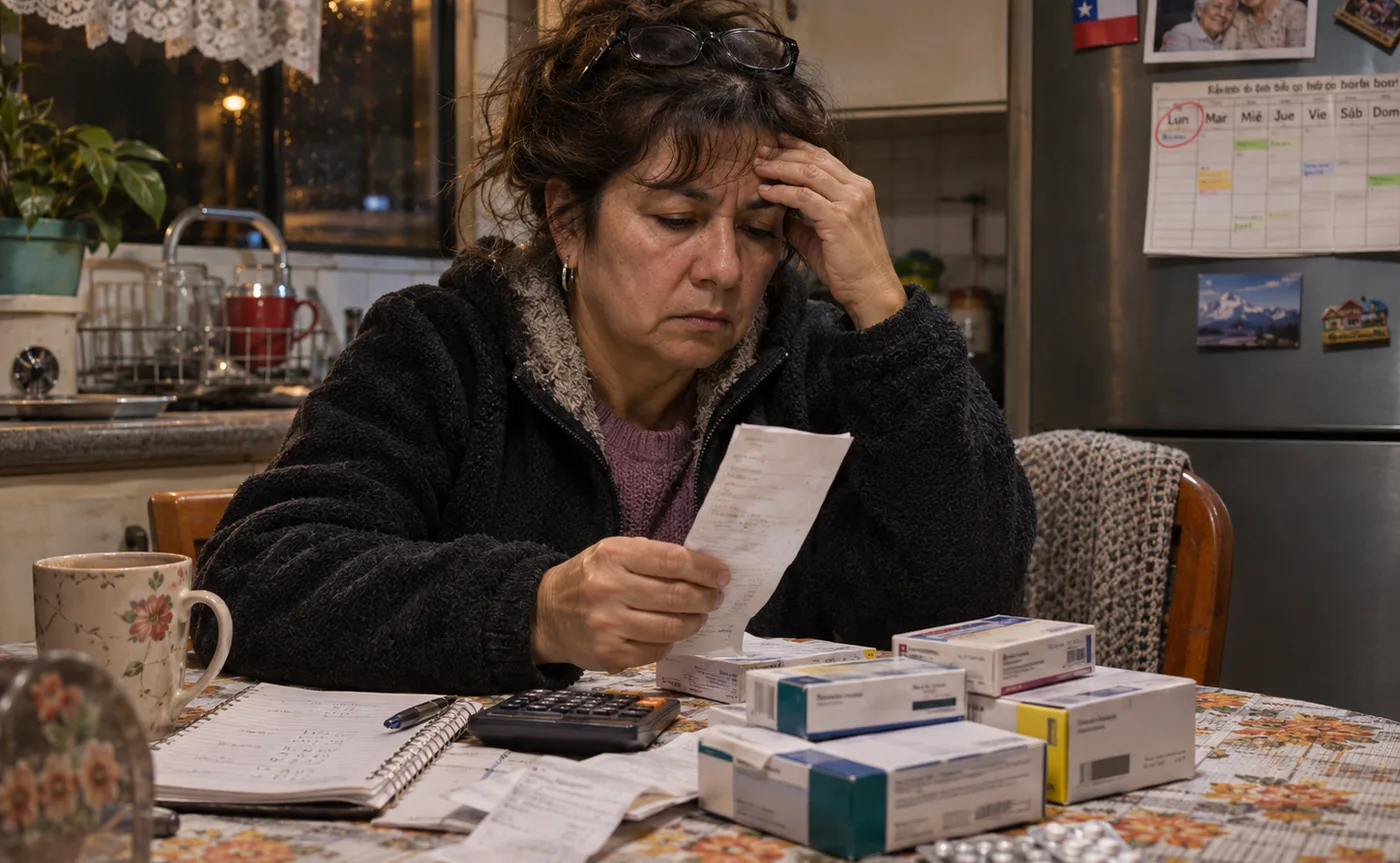
The monthly bill, organised around discount day. Hypothetical scene generated with AI.
Status: desk hypothesis. It is simple and it has an operational consequence: it takes the day of the week out of the price of the enrolled treatment and shifts the central metric from the basket to continuity. Nor is it obvious, because the category competes with discount calendars and store openings. Real recognition is still missing. It would be confirmed by finding that the Club's chronic patients concentrate their purchases on promotion days and skip months. It would be refuted by discovering that most of them buy without looking at the day and without interruptions: in that case the pain is not uncertainty and the proposal loses its basis.
The positioning chain
| Link | Reading for Cruz Verde Chile |
|---|---|
| Real alternatives | Go to the cheapest one (Dr. Simi, Super Sana, pharmacies covered by Cenabast); collect from the public network where there is coverage; buy on a marketplace; ration or postpone the refill. |
| Distinctive capabilities | Existing: the largest network in the country, with more than 890 stores [5] and a presence in remote areas such as Easter Island and Cerro Sombrero [26]; its own website and app [5]; its own distribution and laboratory in Chile [1]. Within the group: a Chronic Patients Programme operating in Colombia, according to content sponsored by the company itself [27]. Inferred: Club purchase history detailed enough to estimate when a pack runs out. |
| Differentiated value | That the treatment does not get interrupted, that the cost of the month is known, and that somebody with judgement reviews the whole combination. |
| Best-fit customers | People who sustain a chronic treatment of their own or of a relative, with two or more medicines, who today organise their purchases around discount days. Cruz Verde already takes part in the Chile Cuida network with benefits for accredited carers [26]. |
| Category | Dominate a poorly served subsegment inside “pharmacy”, without creating a new category: the pharmacy of continuous treatment. |
| Word | Continuity. Dr. Simi already occupies peace of mind through price [3]. Continuity demands network and inventory, which is exactly what Cruz Verde has in abundance. |
05 The vision
Cruz Verde stops being the nearest pharmacy. It becomes the one that takes responsibility for your treatment not being interrupted.
The proposal has a working name, Tratamiento a Cargo (Treatment Taken Care Of), and combines components that only make sense together. A stable price without advance refill is just another discount. An advance refill with a price that changes by the day is just another reminder. The promise to the customer is a single one: you will not run out and you will know what it costs.

Enrolment happens at the counter, in front of a person. Proposed service; hypothetical scene.
The mechanism in four steps
- Enrol. At the counter, with the pharmacist and with explicit consent to use the purchase history and, where the person authorises it, their electronic prescription. No compulsory app.
- Fix. A monthly price for the enrolled treatment, the same on any day of the week, valid for six months except for laboratory list changes notified in advance.
- Anticipate. The system calculates when each pack runs out, prepares the order five days earlier and gives notice. Collection at any store, or delivery.
- Review. A named pharmacist reviews the whole combination twice a year and proposes, where appropriate, bioequivalent alternatives to discuss with the doctor.
| Component | Function | Dependency | Main cost | Observable behaviour | Priority |
|---|---|---|---|---|---|
| Treatment price | Take the day out of the equation | Pricing, checkout, bank agreements | Incremental discount | Purchases outside Mondays and Thursdays | Essential |
| Advance refill | That it does not get interrupted | Network inventory, messaging, consent | Reserved stock, messages | Refill within the window | Essential |
| Named pharmacist | Judgement on the combination | Pharmacist hours | About 25 minutes per patient per half-year (assumption) | Reviews accepted | Amplifier |
| Family account | The carer manages several treatments | App and counter | Low | Profiles added by invitation | Amplifier |
| Free delivery on own stock-out | Repair the failure of the promise | Logistics | Per event | Complaints about missing stock | Test later |
Access. Voluntary and free for Club members with two or more medicines in chronic use. Leaving takes two taps or a word at the counter, and the person keeps their history. First conversion. The critical step is not downloading anything: it is accepting that the pharmacy prepares next month. First value. The first refill ready before the pack runs out, at the agreed price, on any day. Advantage. The feature can be copied; Ahumada already has a subscription [25]. The largest network in the country and a clear promise, by contrast, cost more to copy. It is an execution advantage, not a patent.
The category practice this proposal challenges is the day-of-the-week discount calendar. For the enrolled patient, Monday stops existing. Improving only the operation, with more stock, punctual deliveries and fewer episodes like the 2,780 complaints over a Black Friday coupon in 2024 [28], is necessary, but it keeps Cruz Verde in the same role: the shop that is tolerated because it is nearby.
How the money is made
The same patient pays, with the spending they today split between chains or stop doing when they drop a month. The contribution that funds the promise comes from recovered months. No laboratory would pay to push brands: that would contaminate the pharmacist's judgement, which is the basis of the trust. A plausible third party would be the complementary insurers and isapres that already have agreements with the chain, if adherence reduces their claims. It is a hypothesis: there is no evidence that they are willing to pay.
The calculation that follows is illustrative. All the assumptions are the author's own and none is a Cruz Verde figure: a basket of CLP 35,000 a month at list price, a contribution margin of 35% at list price, half of today's purchases made on 20%-discount days, and purchases at Cruz Verde in 8 out of 12 months.
| Scenario (illustrative) | Contribution per month | Annual contribution | Purchase months needed to match today |
|---|---|---|---|
| Today: half list, half Monday or Thursday | CLP 8,750 average | CLP 70,000 (8 months) | n/a |
| Arm A: Monday price every day (20%) | CLP 5,250 | Depends on the months | 13.3 months: unviable under these assumptions |
| Arm A if 90% already buy on promotion days today | CLP 5,250 | Depends on the months | 9.1 months: viable with +1.1 recovered month |
| Arm B: fixed price close to today's average (10%) | CLP 8,750 | Depends on the months | 8 months: every recovered month adds CLP 8,750 |
The table leaves two conclusions. Giving away Monday every day only pays off if chronic patients already concentrate almost all their purchases on promotion days, and that figure belongs to Cruz Verde, not to the public. A price that stays level on any day, close to what is paid on average today, turns continuity into clean profit. That is why the pilot tests both prices.
Why now and why not before
Since 10 December 2025 the National Electronic Prescription System has been in operation, and the prescription can be used at any establishment in the country [29]. The inertia of the paper kept at the usual pharmacy is over: the refill goes to whoever takes charge first. In August 2026 the Senate reported the approval of the compulsory use of the International Nonproprietary Name in electronic prescriptions, in a bill still going through the legislature [30]. If the prescription names the molecule and not the brand, the decision about which box to take is made at the counter, and the pharmacist's judgement becomes worth more. At the same time, over-the-counter medicine sales are turning into a marketplace product [20][21].
It was not done before because the category is measured by stores and by basket size, and because the discount calendar is an arrangement also funded by the banks [12]. Breaking it for one segment means renegotiating with partners and accepting a different margin per transaction in exchange for more transactions per patient. It is an uncomfortable decision, and that is why nobody took it.
07 Hypothetical pilot scenarios
Fictitious names. None of these situations describes a service Cruz Verde offers today.
Imagine Marisol, 54, Puente Alto, a Monday at 19:40. In her bag she carries the list of her mother's six medicines and her own two. She queues on Monday because Tuesday costs her more. At the counter, the pharmacist offers to enrol the treatment. Marisol answers that she does not want another app. There is no need: the enrolment happens right there, with her ID number and her consent signature, in four minutes.
The mechanism: enrolment happens in front of a person, not on a screen.
Three weeks later, on a Wednesday, Marisol gets a message: her mother's treatment is ready at the Gran Avenida store, at the price of the month. She did not have to wait for Monday or count pills on the kitchen table. She collects it on her way back from work.
The mechanism: the system knows when the pack runs out and the price does not depend on the day.
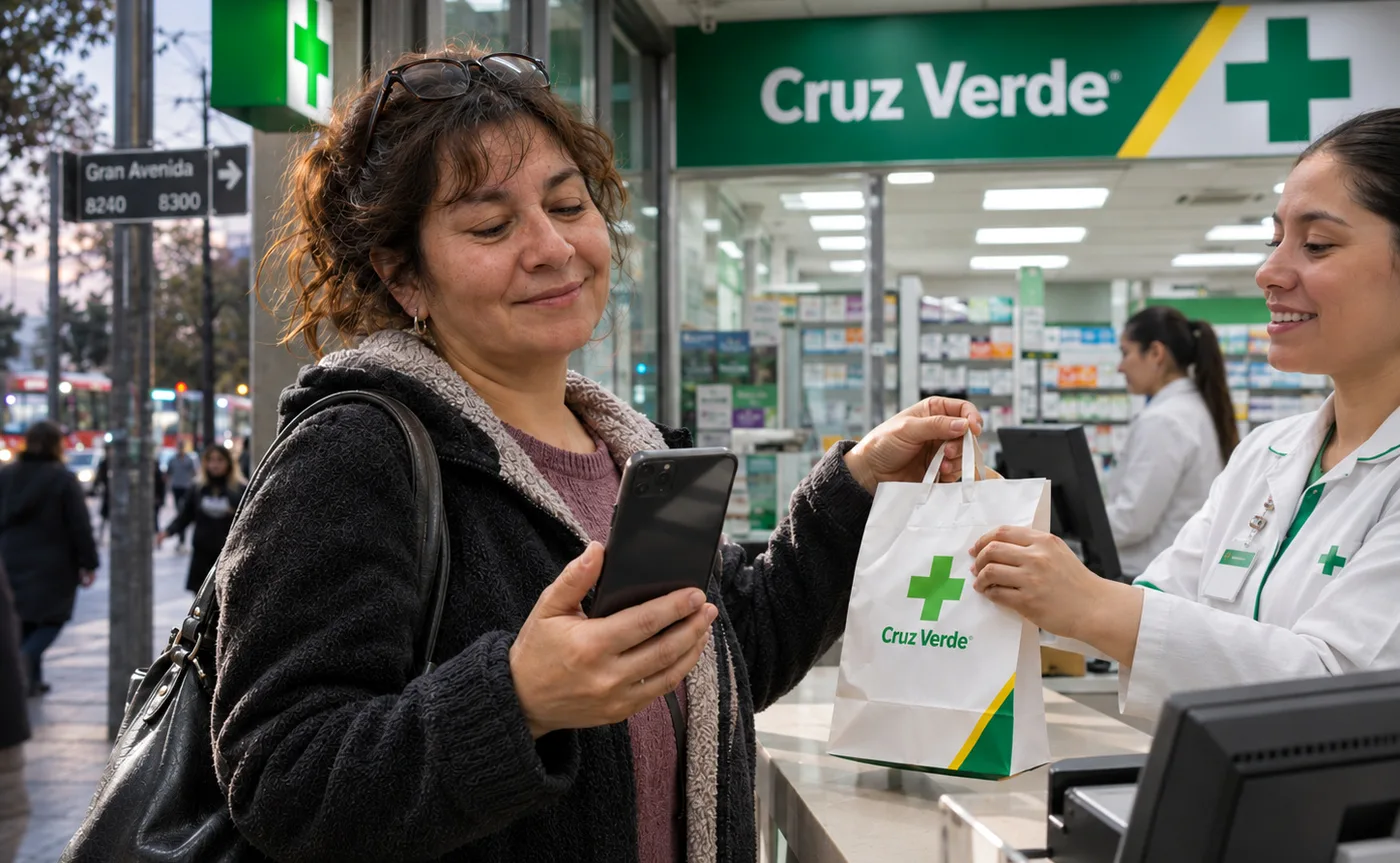
Marisol collects on an ordinary Wednesday, at the price of the month. Hypothetical scenario.
Imagine Hernán, 71, Temuco. He takes seven medicines prescribed by three different doctors. At the first review, the named pharmacist notices that two boxes with different commercial names contain the same active ingredient. He changes nothing on his own: he prints a note for Hernán to raise with his doctor. At the next check-up, Hernán is taken off one box.
The mechanism: a professional with a name looks at the whole combination, not at each box separately.
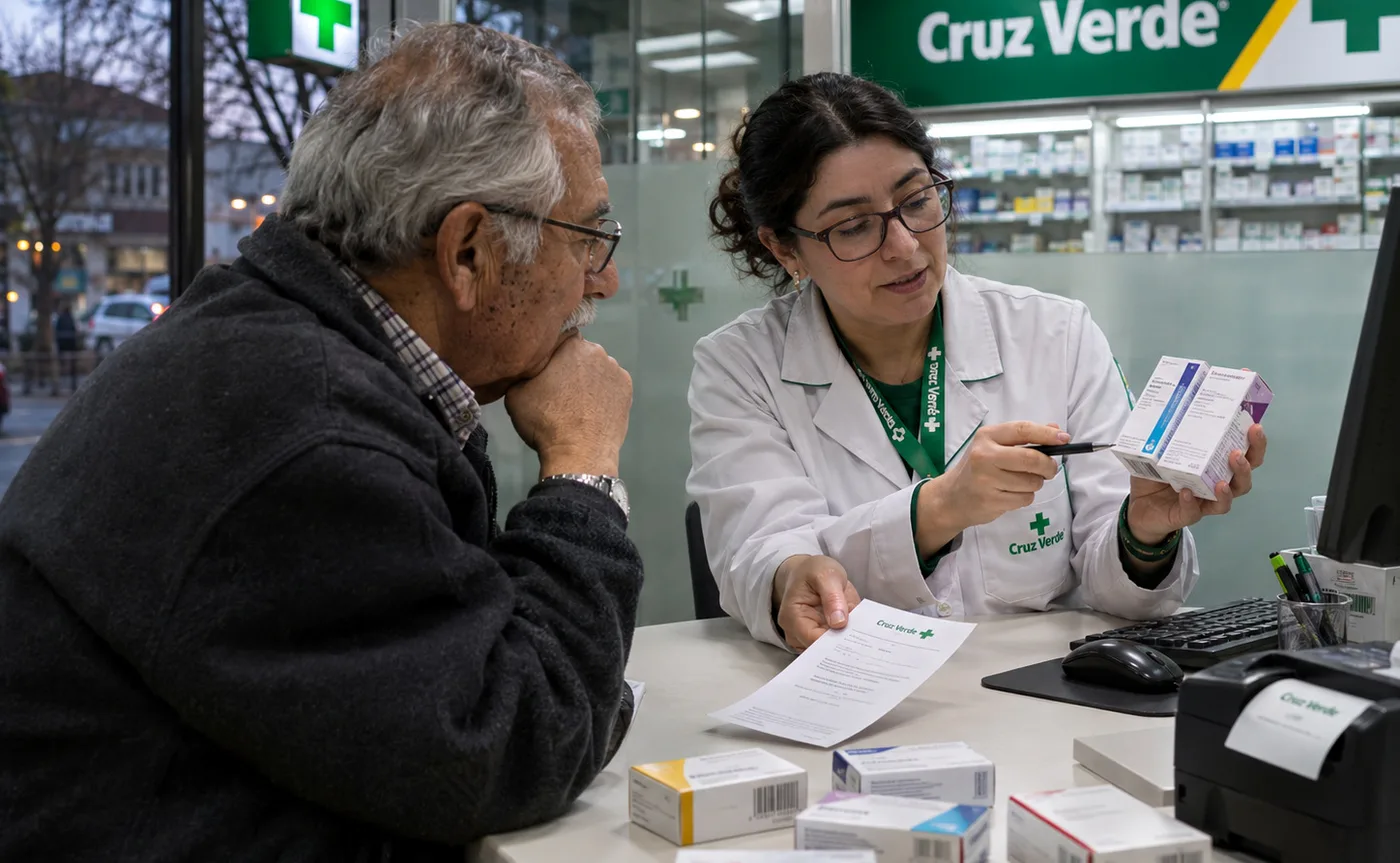
Hernán: the review looks at the whole combination, not at each box. Hypothetical scenario.
Imagine Valentina, 33, Antofagasta. Five days before her refill date, the store where she collects does not have her medicine. The system detects it while preparing the order and brings units from another store in the city. Valentina collects on the expected day and never finds out there was a problem.
The mechanism: for the enrolled patient, the network of more than 890 stores works as a single inventory.
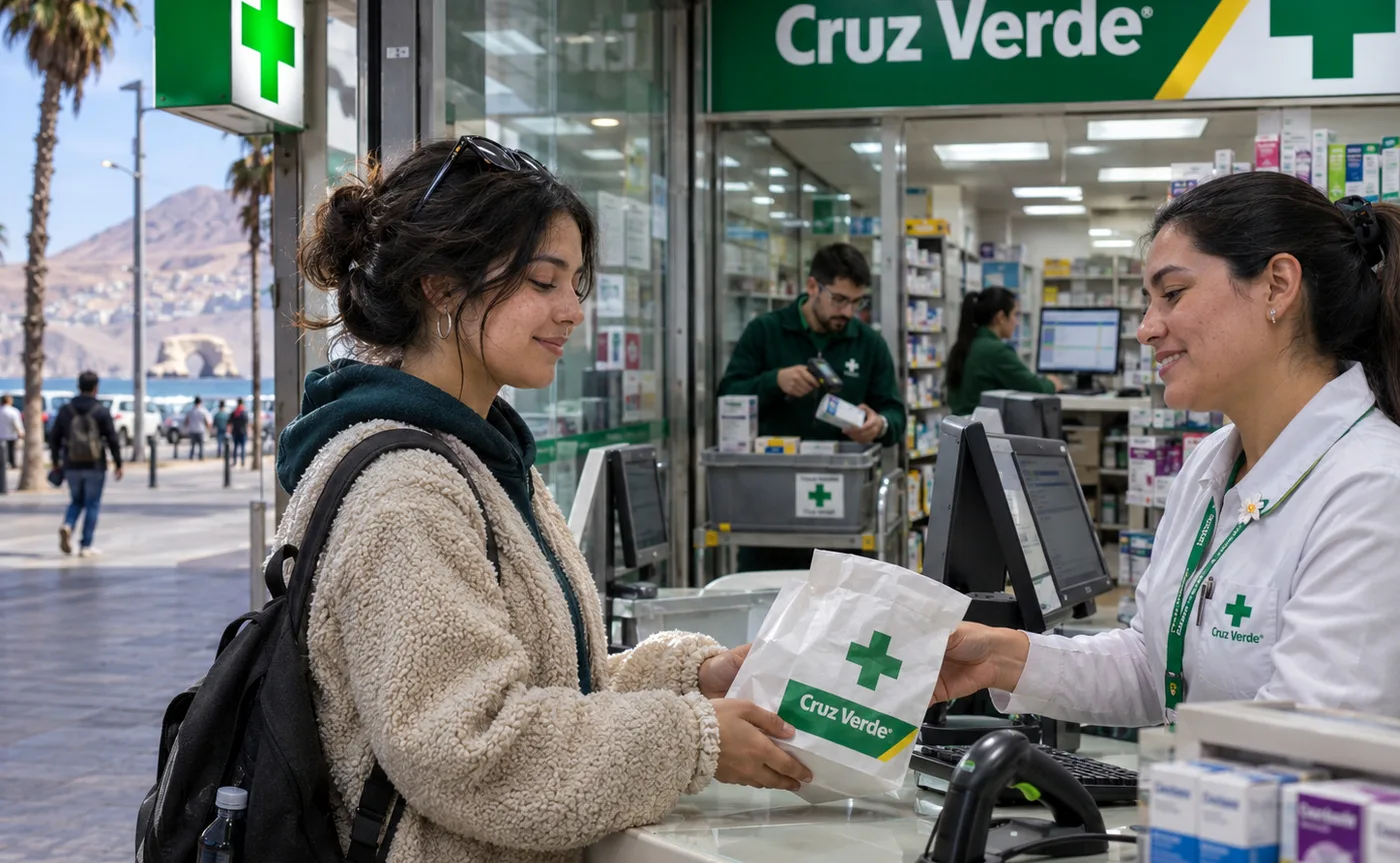
Valentina collects on the expected day: the network works as a single inventory. Hypothetical scenario.
Imagine Jorge, 62, Maipú. He takes generic metformin and atorvastatin, and at a pharmacy covered by the Cenabast Law they are cheaper. He tells the pharmacist he will think about it and the following month he unsubscribes in two taps. Four months later, his cardiologist adds a third, branded medicine. Jorge enrols again because he prefers a single pharmacy to see everything.
The mechanism: leaving has no obstacles, and the proposal wins when the treatment becomes hard to manage, not when the box is the cheapest.
Imagine Carolina, Marisol's sister, in Rancagua. At a Sunday lunch, Marisol tells her that their mother's medicine is no longer an issue. Carolina adds her father, who lives with her, to the same family account. The invitation is recorded with a code.
The mechanism: the family account turns the carer into the one who recommends, and the recommendation can be counted.
The proposed pilot: 90 days
Main hypothesis. If Cruz Verde offers patients on chronic treatment a system combining a stable price, advance refill and professional review, the continuity of their purchases should rise against comparable patients, because forgetfulness, the wait for discount day and the doubt about what to buy all disappear. Price and refill are tested together because together they form the promise. The only component whose contribution is isolated is the price level, with two arms. The contribution of the named pharmacist and of the family account cannot be attributed separately: the design only allows conclusions about the whole.
| Field | Proposal |
|---|---|
| 1. Units | 30 pilot stores (20 in the Santiago Metropolitan Region and 10 in Biobío) and 30 control stores matched by size and area. Arm A in 15 stores, arm B in another 15, assigned at random. Target cohort: 3,000 voluntarily enrolled patients. Proposed units, not committed resources. |
| 2. Timeframe | Two weeks of instrumentation and baseline. Ninety days of operation with milestones on days 30 and 60. Decision on day 90 and review on day 120. |
| 3. Baseline | Twelve months of Club history for eligible patients in pilot and control stores: months with a purchase, share of purchases on Mondays or Thursdays, days between purchases against the theoretical duration of the pack, and contribution per patient. Without this data, the pilot is not cleared to compare results. |
| 4. Metrics with targets | Continuity: refills made no later than 3 days after the theoretical end date, over expected refills; provisional target of +10 points against control. Months with a purchase: patients with a purchase in the 3 months of the window. Contribution per patient per month: arm B equal to or above control; arm A with losses capped at the agreed limit. Refill stock-outs: under 3%. The definitive targets are set with the baseline, before day 1. |
| 5. Desire metrics | Sought out: spontaneous enrolment requests from stores outside the pilot, from the web or by phone, with no paid advertising, and searches for the programme's name. Repeated: continuity and months with a purchase, by entry cohort. Recommended: family profiles added by coded invitation, kept separate from any incentive. |
| 6. Condition to scale | On day 90: continuity +8 points or more against control, contribution no lower than control in at least one arm, stock-outs under 3% and programme complaints below the chain's base rate. |
| 7. Condition to stop | On day 60: continuity below +3 points against control, or accumulated contribution loss above 25% of the budget, or stock-outs above 8%. Stop, correct or go back to the diagnosis; the rule is not changed afterwards. |
| 8. Agreed exit | Thirty days' notice. The agreed price is honoured until the end of the following month and prepared orders are delivered. Patients return to the standard Club without losing their history. Data is handled according to consent, with an option to delete. Pharmacists return to their usual role. This is the exit that would have to be negotiated, not one already agreed. |
Proposed maximum budget (illustrative): CLP 180 million. Up to CLP 90 million in incremental discount; CLP 25 million in pharmacist hours and cover; CLP 35 million in technology and messaging; CLP 15 million in in-store material and training; CLP 15 million for an independent measurement. Suggested funding: reallocating the Club's promotional budget in the pilot stores.
Owners by function. Sponsorship: general management of FEMSA Salud Chile. Pilot owner: Club and CRM management. Clinical operation: regional pharmacist. Pricing and bank agreements: pricing. Inventory: logistics. Measurement: analytics, with external review. Consent and data: legal.
Risks that can invalidate the mechanism
| Risk | Measure |
|---|---|
| That the patient feels their history is being watched | Voluntary enrolment in front of a person, explicit consent, use limited to the refill and immediate exit. |
| That the discount is a certain cost while continuity is uncertain | Two price arms, a loss cap and a stop on day 60. |
| That a refill fails and breaks the promise | Stock reserved across the network and replacement delivery; stock-outs measured as a condition to scale. |
| That the pharmacist ends up pushing brands | No laboratory incentives in the programme and documented review. The profession is already watching channel changes closely [31]. |
| That the partner banks resist the change of calendar | The general calendar stays the same; the pilot only affects the enrolled treatment. |
How the result is read
If searches rise and continuity does not, there was curiosity without sustained value. If continuity rises and recommendation does not, the service works but something prevents people from talking about it, perhaps the awkwardness of discussing medicines. If recommendation rises and continuity does not, the anecdote travels and the experience does not retain. If all three improve, there is a converging signal of desire, and it scales only if the economic conditions are met. If none improves, the measurement is reviewed and, where appropriate, the work goes back to the insight. None of these readings replaces the comparison against the control group.
14 The new reality
From that day on, Cruz Verde stops competing for Monday. It competes for something no Chilean chain promises today in a single sentence: that your treatment will not be interrupted and that you will know what the month costs. Dr. Simi can go on being the pharmacy that gives peace of mind through price. Cruz Verde does not need to win that fight. It needs that, for the person who sustains somebody else's six medicines, changing pharmacy means going back to carrying it alone.
Marisol no longer writes on the fridge when her mother's medicine runs out. The pharmacy knows before she does.
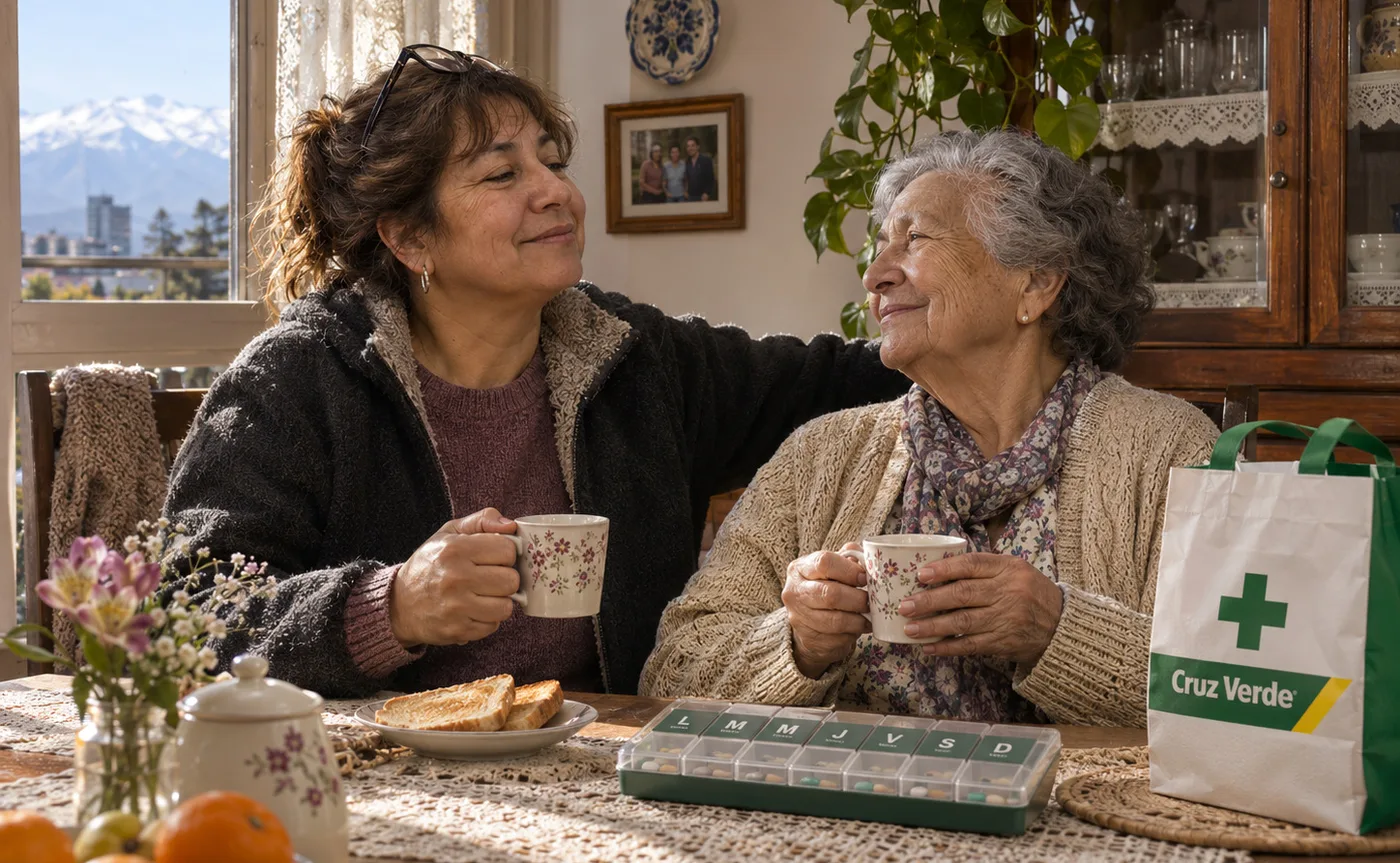
The new reality: the medicine stopped being an issue. Hypothetical scene generated with AI.
What is necessary is tolerated. What is desired is sought out, repeated and recommended.
Note on independence and limits
This autopsy is an independent analysis carried out with public sources. It does not claim access to internal information from Cruz Verde or FEMSA, nor any commission or validation from the company. The scenes are hypothetical and the figures in the proposal and the pilot are proposals or illustrations, not results. The trademarks, logos and trade names cited belong to their respective owners and are used to identify the object of the analysis; no sponsorship or approval is claimed.
Source log
All sources consulted on 17 November 2026. Press reports are cited for what they report; where a figure comes from a third-party study, the author of the study is named in the text. Content sponsored by companies is identified as such.
- FEMSA. “FEMSA Salud” (corporate page). Consulted 17 November 2026. femsa.com
- Cadem. “Plaza Pública N°71, agosto semana 4, 2025” (ranking: which is your preferred pharmacy?). August 2025. cadem.cl
- Emol. “Farmacias del Dr. Simi se posiciona entre las marcas con mayor conexión emocional en Chile” (Criteria study). 14 October 2026. emol.com
- La Tercera. “La historia detrás del Dr Simi, el ícono de las farmacias baratas que llegó a Chile desde México”. Date not stated in the extract consulted. latercera.com
- Emol. “Cruz Verde y Mercado Libre sellan alianza para la venta electrónica de medicamentos”. 28 August 2026. emol.com
- Ahrefs. “cruzverde.cl: website traffic and keywords” (third-party estimate, Chile). Consulted 17 November 2026. ahrefs.com
- Chócale. “Chilenos priorizan rapidez y conveniencia por sobre el precio en compras de salud” (Retail Preference Index, dunnhumby). 1 February 2026. chocale.cl
- Chócale. “Mercado Libre, Latam y Bci lideran la reputación empresarial en Chile según Merco 2025”. December 2025. chocale.cl
- Cooperativa. “Grandes cadenas de farmacias deberán pagar compensaciones a clientes tras colusión”. 20 December 2019. cooperativa.cl
- La Tercera, legal notices. Settlement notice, case Rol C-1940-2013, 10th Civil Court of Santiago (approved on 8 August 2025). September 2025. avisoslegales.latercera.com
- En Cancha. “Recibe un 20% de descuento en Cruz Verde estos dos días de la semana”. 20 July 2024. encancha.cl
- Banco de Chile. “Beneficios: Farmacias Cruz Verde” (terms in force until 30 June 2026). bancochile.cl
- Diario Financiero. “Femsa no se intimida por la férrea competencia y busca superar las 1.000 [farmacias]” (interview with Daniel Belaúnde, general manager of FEMSA Salud). Date not stated in the extract consulted; before 2025. df.cl
- America Retail. “El boom de las farmacias en Santiago cambia el mapa del comercio urbano” (GPS Property analysis). 22 June 2026. americaretail-malls.com
- Emol. “Grandes cadenas de farmacias recuperan terreno” (Xbrein report). 10 November 2026. emol.com
- Merca2.0. Report on the expansion of Farmacias del Dr. Simi in Chile (600 stores in 2025). 2025. merca20.com
- Diario Financiero. “Femsa lanza su tercera cadena de farmacias en Chile, esta vez apostando por un formato low cost”. October 2025. df.cl
- El Dínamo. “Hasta 90% más baratos: los 32 medicamentos que bajan de precio gracias a Ley Cenabast y dónde comprarlos”. 1 July 2026. eldinamo.cl
- Radio Agricultura. “Medicamentos hasta 90% más baratos: 413 sucursales de Farmacias Ahumada se incorporan a Ley Cenabast”. 8 October 2026. radioagricultura.cl
- Chócale. “Farmacias Cruz Verde comenzará a vender medicamentos en Mercado Libre”. August 2026. chocale.cl
- The Clinic. “La batalla por la venta de medicamentos y dermocosmética online: Cencosud y Falabella buscan disputarle terreno a Mercado Libre”. 26 September 2026. theclinic.cl
- Chamber of Deputies of Chile. “Comisión de Salud analiza gasto en medicamentos”. 6 November 2025. camara.cl
- Revista Confluencia (Universidad del Desarrollo). Review of medication adherence in older adults with hypertension and/or type 2 diabetes mellitus. 2020. revistas.udd.cl
- Chócale. “Descuentos en medicamentos: los programas de beneficios de las farmacias”. August 2022. chocale.cl
- BioBioChile (sponsored content). “Farmacias Ahumada implementa suscripción de recetas para enfrentar baja adherencia a tratamientos”. 25 August 2022. biobiochile.cl
- Ministry of Social Development and Family (Chile). “Cerca de mil 500 personas cuidadoras accederán a los beneficios de la Red de Empresas Chile Cuida…”. Date not stated in the extract consulted. desarrollosocialyfamilia.gob.cl
- El Espectador, sponsored content “Cruz Verde le cuenta”. “Innovación en salud: propuesta de Cruz Verde por el país que soñamos” (Chronic Patients Programme, Colombia). 2026. elespectador.com
- SERNAC. “El código de $5 mil de Cruz Verde que dio lugar a cerca de 3 mil reclamos y a inicio de fiscalización de SERNAC”. 10 December 2024. sernac.cl
- Meganoticias. “Receta médica electrónica: ¿Cómo será el nuevo sistema que funcionará con Clave Única?”. 11 December 2025. meganoticias.cl
- Senate of Chile. “Aprueban uso obligatorio de la Denominación Común Internacional en las recetas electrónicas”. 11 August 2026. senado.cl
- Emol. “La resistencia de químicos farmacéuticos a la alianza entre Cruz Verde y Mercado Libre por venta de medicamentos”. 3 September 2026. emol.com
Someone who takes medication every month is not buying boxes: they are paying a fixed bill. And nobody desires a bill that changes depending on the day of the week.
In this category desire exists. Somebody else has it.
Marisol no longer writes on the fridge when her mother's medicine runs out. The pharmacy knows before she does.
The verdict
What is necessary is tolerated. What is desired is sought out, repeated and recommended. This pilot measures all three.
What would an autopsy of your business say?
Every new autopsy reaches the list first: the short version, the key finding and a few extra things I don't publish anywhere. No spam, no discounts, no "last chance".
Get the autopsies before anyone else →