Autopsy Nº 04·Regional
El Emporio de los Sándwiches
The brand that still owns the category name, but let the desire go elsewhere
- BRAND ANALYZED:
- El Emporio de los Sándwiches
- Industry
- Dining
- Country
- Uruguay
- Published
- August 3, 2026
In five lines
Ninety years and the category name: El Emporio already owns the ground any new bakery would want to occupy. What it does not have is a sandwich worth crossing Montevideo for. Hundreds of references, the beige tray of forty identical pieces, and a café that modernizes the façade but not the reason to walk in. Raffling cars generates purchases, not a cult. Nobody queues to say they got an entry. The way out is to choose: fewer products, one that is beyond argument, and sandwiches that could only be from Montevideo.
FactDESIRE AUTOPSY FactEL EMPORIO DE FactThe brand that still owns the name of the category, ILLUSTRATED STRATEGIC ANALYSIS 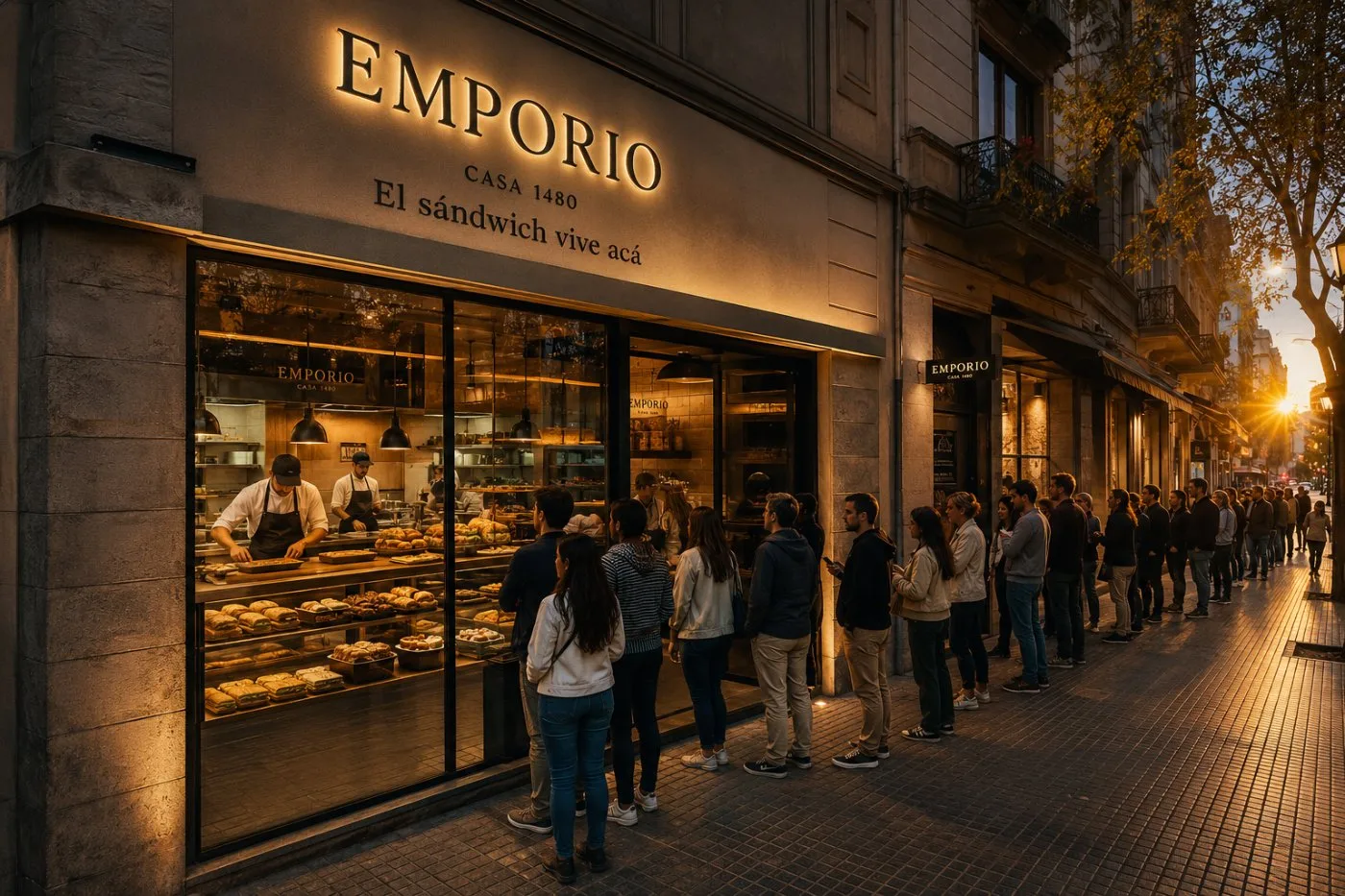 Prepared by Ariel Pfeffer · arielpfeffer@gmail.com LIFE REWARDS ACTION! |
“A ninety-year-old brand has no right to live off memory. It has an obligation to make people hungry again.” |
El Emporio is not dead. That would be simpler. You lower the shutters, send a wreath, and someone asks whether the sandwiches left over can be taken home.
The problem is considerably more uncomfortable: it is alive. It has history, production, refrigerated delivery, e-commerce, telephone service, familiar products, and a network of stores covering different consumption occasions. It works. And precisely for that reason, no one feels any urgency to bring it back to life.
A company that is not selling knows it has a problem. A company that keeps selling because of history, convenience, habit, or because someone has a birthday on Sunday can take decades to discover something worse: it is no longer desired.
The standard for this autopsy is not whether the cash register records sales. It is whether there is something only this brand can offer, whether the experience stays in memory, and whether, when a similar need arises, the customer thinks of it first instead of comparing everything again from scratch. What is necessary is tolerated. What is desired is sought out, repeated, and recommended.
Today, Emporio has recognition. What it does not yet have is hunger surrounding it.
I. THE BODY
For anyone who has never known Emporio
El Emporio de los Sándwiches is a Uruguayan company founded in 1936. Its story begins with Ramón and Santiago Masliah selling sandwiches at Playa Ramírez. Over time, the company built a singular position: it is not a bakery that also sells sandwiches, nor a catering company that happens to include them. It is called El Emporio de los Sándwiches.
That matters. In marketing, a name can be a sentence or a piece of real estate in the consumer's mind. Emporio already owns a property that any new premium bakery would give an arm—preferably the one it does not use for kneading—to occupy.
Its flagship location is at 1480 Rondeau Avenue. From there, it produces and distributes to the other stores and throughout the metropolitan area. The company preserves products it presents as its own traditional creations: arrolladitos, francesitos, and the Espuma de Mar dessert. For generations, Emporio has been associated with birthdays, family gatherings, farewells, anniversaries, office lunches, cocktail trays, and that occasion when no one wanted to cook but everyone wanted to have an opinion.
It was not merely food. It was social infrastructure. In many Uruguayan homes, an Emporio tray amounted to a silent declaration: “We did not cook, but we have not completely abandoned ourselves either.”
That cultural place has value. The problem is that society changed, gastronomy changed, the way food is displayed changed, and visual expectations changed. The sandwich stopped being merely a discreet vehicle for ham and cheese. It became a gastronomic object: fermented breads, high-hydration focaccias, meats cooked for hours, special cheeses, cuts opened in front of the customer, and combinations worth traveling to another neighborhood for.
Buenos Aires developed a scene in which the focaccia sandwich is sold as a reason to make the trip, not as a resigned solution for lunch. Emporio possesses something those businesses do not: ninety years of legitimacy and a name that already contains the category. But it is not using that advantage with enough ambition.
II. CAUSE OF DEATH
It does not have a variety problem. It has variety poisoning.
Emporio's online store brings together hundreds of items across sandwiches, sweets, savory bites, lunch spreads, and gifts. That looks like abundance. In reality, it is fog.
When a company offers hundreds of products without a brutally clear hierarchy, it forces the customer to do the strategic work the company failed to do. The consumer arrives and finds a catalog. They do not find an answer to the question that creates lines: what is here that I need to try before I die?
Emporio can say which products are its oldest. It can say which ones it sells by the dozen. It can say which ones go into a lunch spread for fifteen people. What it cannot say today with indisputable authority is: “This is the sandwich worth crossing Montevideo for.” And a brand called El Emporio de los Sándwiches should not have just one. It should have several.
The catalog already contains contemporary ingredients, but they usually appear buried among dozens of alternatives and without a ritual that turns them into a destination. It is like hiring Robert De Niro to appear for three seconds behind a plant. The talent is there. The staging is not.
The most important product does not exist
Food brands capable of creating pilgrimages usually have a product that serves as ambassador, password, and proof. It is not necessarily the most expensive or the most sophisticated. It is the one someone can name in a sentence.
Emporio has Espuma de Mar, arrolladitos, and francesitos. But none is currently designed, presented, and distributed as the product that monopolizes a national conversation. Preserving a recipe is not the same as keeping a myth alive. A relic sits still behind glass. A myth keeps recruiting believers.
Tradition became an alibiInference
Continuity has historical value. It also contains a risk: confusing loyalty with immobility. A recipe can preserve its essence while improving the bread, texture, temperature, presentation, size, way of serving, packaging, accompanying story, and place on the menu.
Tradition should be a launchpad. Not a gold-embroidered straitjacket. The food industry is full of businesses saying, “We make it exactly as we did forty years ago,” expecting that to always be a virtue. Sometimes it means, “We did not touch a perfect recipe.” Other times it means, “No one dared ask whether it is still perfect.”
The brand sells celebration, but it lost Tuesday
The lunch-spread business should remain: it is relevant, understandable, and produces high tickets. But a brand does not generate lines all day by waiting for someone to get married, have a birthday, or call a board meeting.
Emporio needs to recover everyday consumption: Tuesday breakfast, the lunch someone starts craving at eleven, the afternoon treat worth taking a detour for, the dessert bought when nobody is celebrating anything, and the sandwich a person eats alone without pretending to have organized an event.
“Celebration is a market. Craving is a frequency.” |
Emporio trained itself to solve occasions. Now it must learn again how to provoke desire without a prior invitation.
Emporio Café tried to increase frequency, but confused format with meaning
Emporio Café was created to modernize the brand and increase visit frequency. The intention was right. The common mistake is believing that opening a coffee shop automatically modernizes a brand. It does not. An espresso machine does not rejuvenate anything by itself. Gas stations have them too.
For Emporio Café to have a powerful identity, it needed to answer why someone would choose to drink coffee there rather than at any of the hundreds of places serving coffee. The answer could not be “because we have chairs.” It had to be: “Because this is the only café built around Uruguay's best sandwiches and cult desserts.”
Public reviews show positive experiences, but also warning signs involving waits, understaffing, dry products, lukewarm coffee, and an unsatisfactory price-to-quality relationship. Especially when several people use the same word: dry. In a company whose main product contains bread, “dry” is not an aesthetic opinion. It is a medical report.
Water in the soup
Traditional brands rarely collapse overnight. They get diluted. A little less filling. A little more waiting. A product left on display too long. A recipe that keeps its name but loses intensity. A branch with one person serving when there should be three. Coffee arriving lukewarm.
No single decline kills the brand. The problem is accumulation. The customer keeps buying because they know it, because it is nearby, or because they do not want to research alternatives. They do not always complain. They simply stop admiring.
And when a brand loses admiration, the customer may remain a customer for years. What they stop being is a voluntary salesperson. That is the most expensive deterioration: it does not appear as a return. It appears as silence.
The ninetieth-anniversary promotion celebrates age, not relevance
A promotion can increase the ticket without building desire. Giving people chances to win cars reveals the difference between generating purchases and building a cult. A person may spend more because they want a chance. That does not prove they are in love with the sandwiches. It proves they can count.
The unintended message becomes: “Buy our sandwiches and perhaps you will win something you actually want.” The prize should have been the brand. A car can attract transactions. It does not build a gastronomic cult. No one stands in a historic line to say they earned an entry. They stand in line to say: “I tried it before you did.”
III. THE ENEMY
No more sad trays
Emporio's real competitor is not another bakery. Nor is it a specialty café or a delivery app. It is the sad tray.
The sad tray is that beige surface with forty pieces that seem manufactured so nobody will argue. It does not offend. It does not excite either. It appears at a gathering. It performs a function. It disappears. Nobody asks where it came from. Nobody takes a picture. Nobody remembers which one was their favorite because they all looked like cousins who do not speak much.
The sad tray represents an old way of thinking about the sandwich: administrative food. Emporio should declare war on that idea. Not abandon its trays. Turn them into the opposite.
The box must arrive and cause a small movement in the room. Someone has to look. Someone has to ask. Someone has to try to remain nearby when it is opened.
IV. WHAT THE CUSTOMER REALLY WANTS
The host wants to protect their reputation
The person ordering a lunch spread does not want a list of pieces. They want enough food, on time, fresh, praised by the guests, and they do not want to spend the evening counting trays like an air traffic controller armed with mayonnaise.
Emotionally, they are not buying food. They are buying peace of mind and social approval. Their worst fear is not spending a little more. It is someone picking up the last croissant while more guests are still on the way.
The individual customer wants to reward themselves
The person walking in at four in the afternoon is not solving a nutritional need. They are saying, “It has been a long day. I deserve this.” That person does not want a display case with forty equivalent products. They want to see something and think: “That.”
The young customer wants to discover and show
They do not necessarily want tradition. They want an experience they can incorporate into their identity. They do not want to visit a museum where food also happens to be served. They want to discover something with history that still feels alive.
The longtime customer wants recognition without finding exactly the same thing
The longtime customer should not be expelled in the name of modernity. They should find their arrolladitos, francesitos, mixtos, and Espuma de Mar. But they should also feel that the brand they remember was not abandoned in a display case. The best tribute to a longtime customer is not freezing the company. It is showing them that their trust allowed it to evolve.
V. 1936, 1480, OR NEITHER
1936 represents origin. It says: we know how to do this; we survived; we have recipes; we did not discover focaccia the day before yesterday on TikTok. It is proof. But as the lead name, it can pull the brand too far backward.
1480 represents place. It is the historic Rondeau address and matches the ending of the historic telephone number. It has rhythm, is easy to remember, and enables useful phrases: “See you at 1480,” “It came out of 1480,” “the Casa 1480 recipe.” But there is not enough evidence to claim it already works spontaneously as a popular nickname. Today it is a recognizable address for part of the public, not a consolidated cultural brand.
That is why Emporio should not be replaced by a number. It would mean surrendering an extraordinary property to adopt a code that still needs explanation.
ELEMENT | FUNCTION |
EMPORIO | The brand people know |
CASA 1480 | The place people make a pilgrimage to |
SINCE 1936 | The reason people trust it |
The recommended architecture is: EMPORIO as the brand; Casa 1480 as the flagship, laboratory, stage, and visible place of origin; Since 1936 as the seal of provenance and authority.
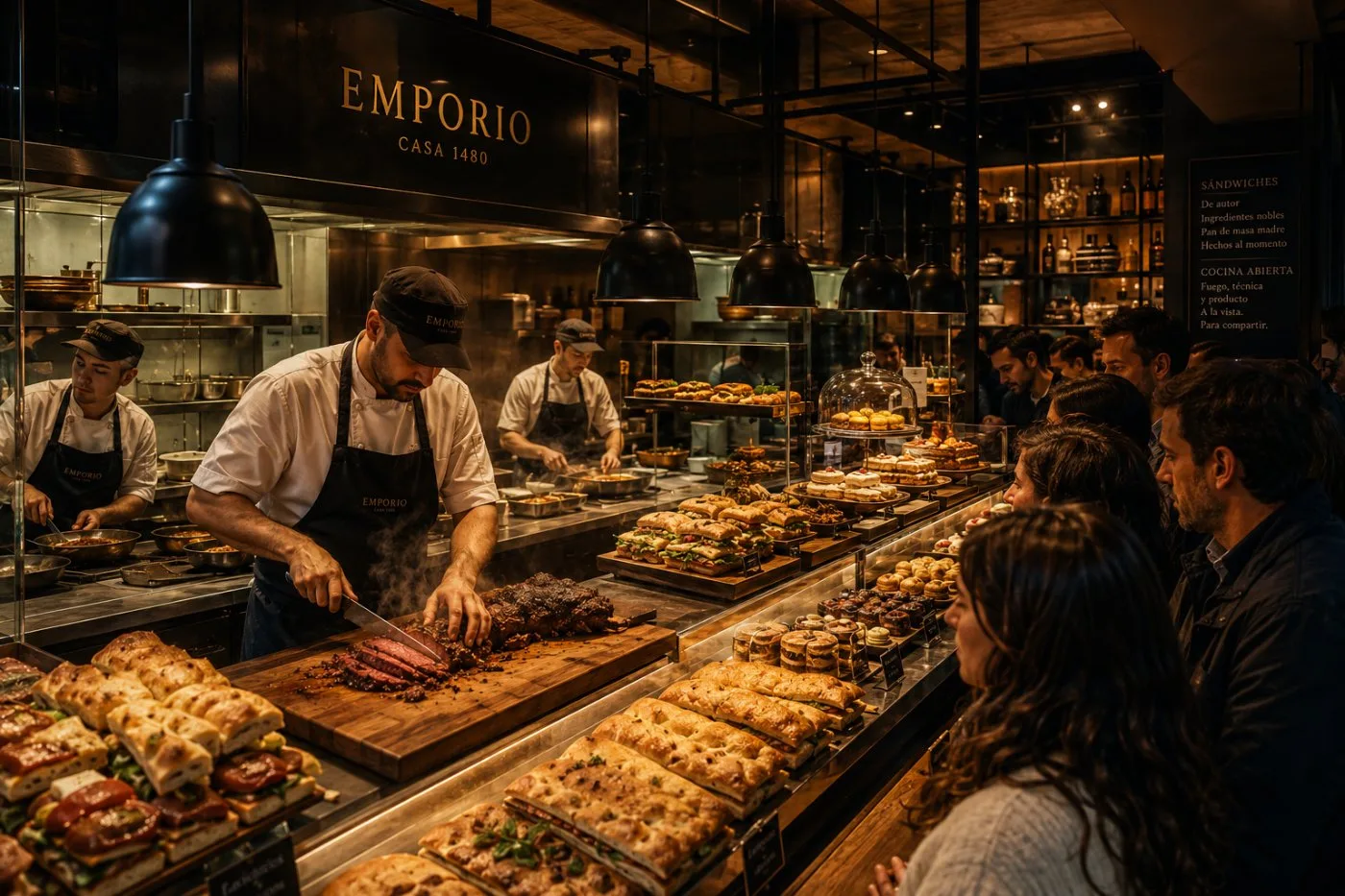
Casa 1480: visible production, open kitchen, and gastronomic theater. The magic is not hidden in a plant; it happens in front of the customer.
VI. THE RESURRECTION
Emporio must once again own the sandwich
It should not try to become a generic café with good cakes. It should not hide its name to look like a new bakery. It should not copy the beige palette and thin typography so many brands use to announce that they have discovered sourdough.
It must do something harder: turn the Uruguayan sandwich into a cult category.
The new menu should be organized into three worlds: The Everlasting, preserving and perfecting historic products; The New Icons, between seven and ten large, recognizable sandwiches; and Sweet Cult, five or six products people would visit the store specifically to buy.
“Nothing enters the menu merely to complete a category. It enters because someone would be willing to cross the city to eat it.” |
VII. THE NEW SAVORY ICONS
1. The Perfect Mixto
Ham and cheese look easy. Singing looks easy too, until someone tries it near another human being. The Perfect Mixto must prove that Emporio can take the most familiar thing and make it extraordinary.
Its own sandwich bread, baked daily, with precise moisture and a slightly thicker cut than industrial bread. Cultured butter with a touch of salt. Natural cooked ham. Colonia and Danbo cheeses in a combination designed to melt. It is assembled to a fixed ratio, pressed for a specified time, and finished on a griddle that leaves the exterior lightly crisp while the center stays moist.
It should not be huge. It should be perfect. It is served cut into two rectangles, with the cheese visible. The promise is deliberately ambitious: “The best ham-and-cheese sandwich in the Río de la Plata.”
“Ham, cheese, and ninety years to discover it was not that simple.” |
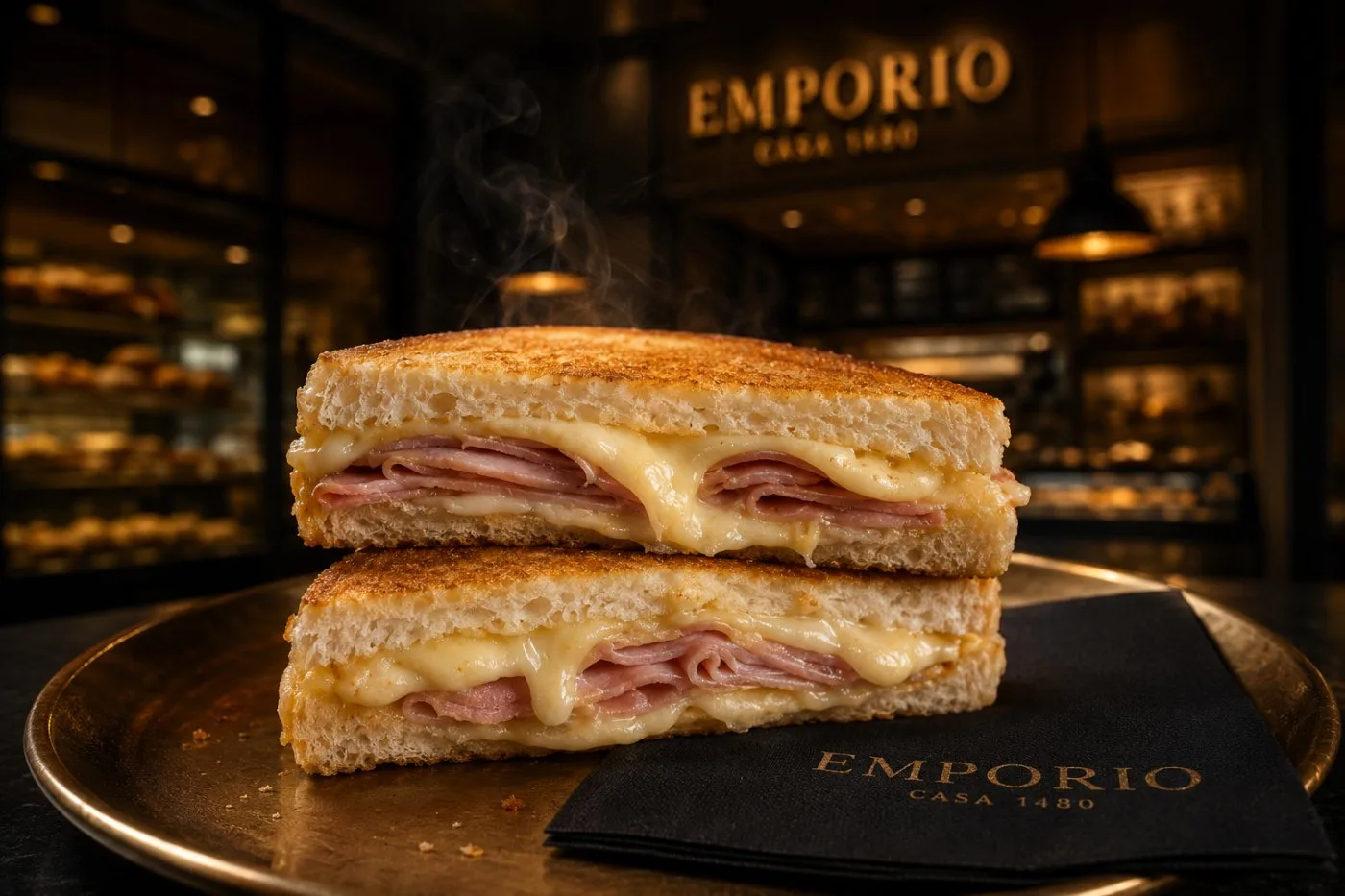
The Perfect Mixto: proof that an icon does not need to be extravagant; it needs to be unassailable.
2. The Mortadella
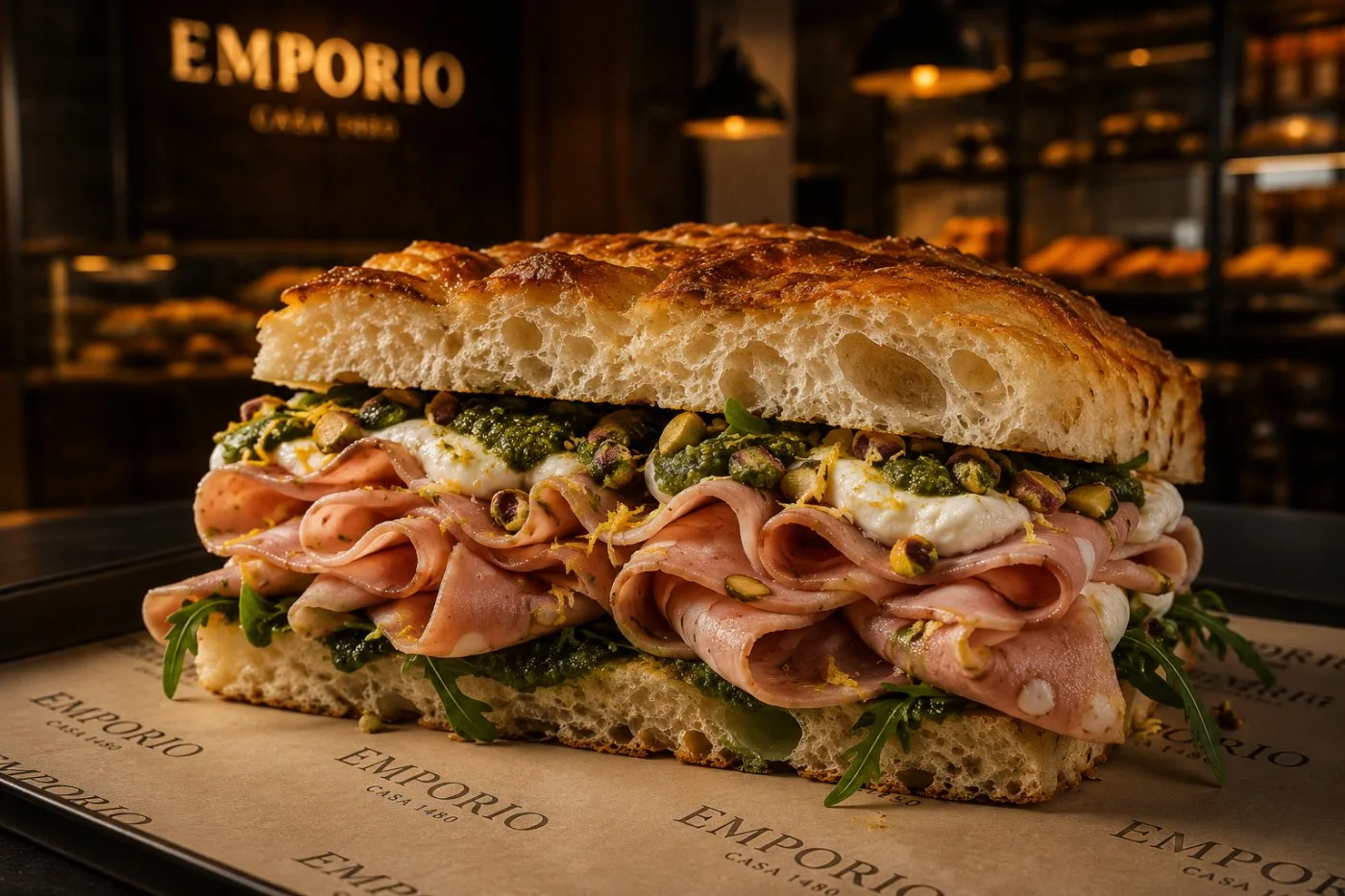
Not six cocktail-size pieces hidden among other results. A starring sandwich: high-hydration focaccia made with a 24-hour preferment, very thinly sliced pistachio mortadella, stracciatella, fresh pesto, toasted pistachios, lemon zest, arugula, and olive oil.
The focaccia is finished in the store. The mortadella is folded, not flattened. The interior must be recognizable on video without anyone needing to write, “Look how delicious.”
“This is not a discreet sandwich. You did not come all this way to be discreet either.” |
3. Pastrami Rondeau
The Casa 1480 sandwich. It should not initially be sold at every branch. An exclusive product turns an address into a destination.
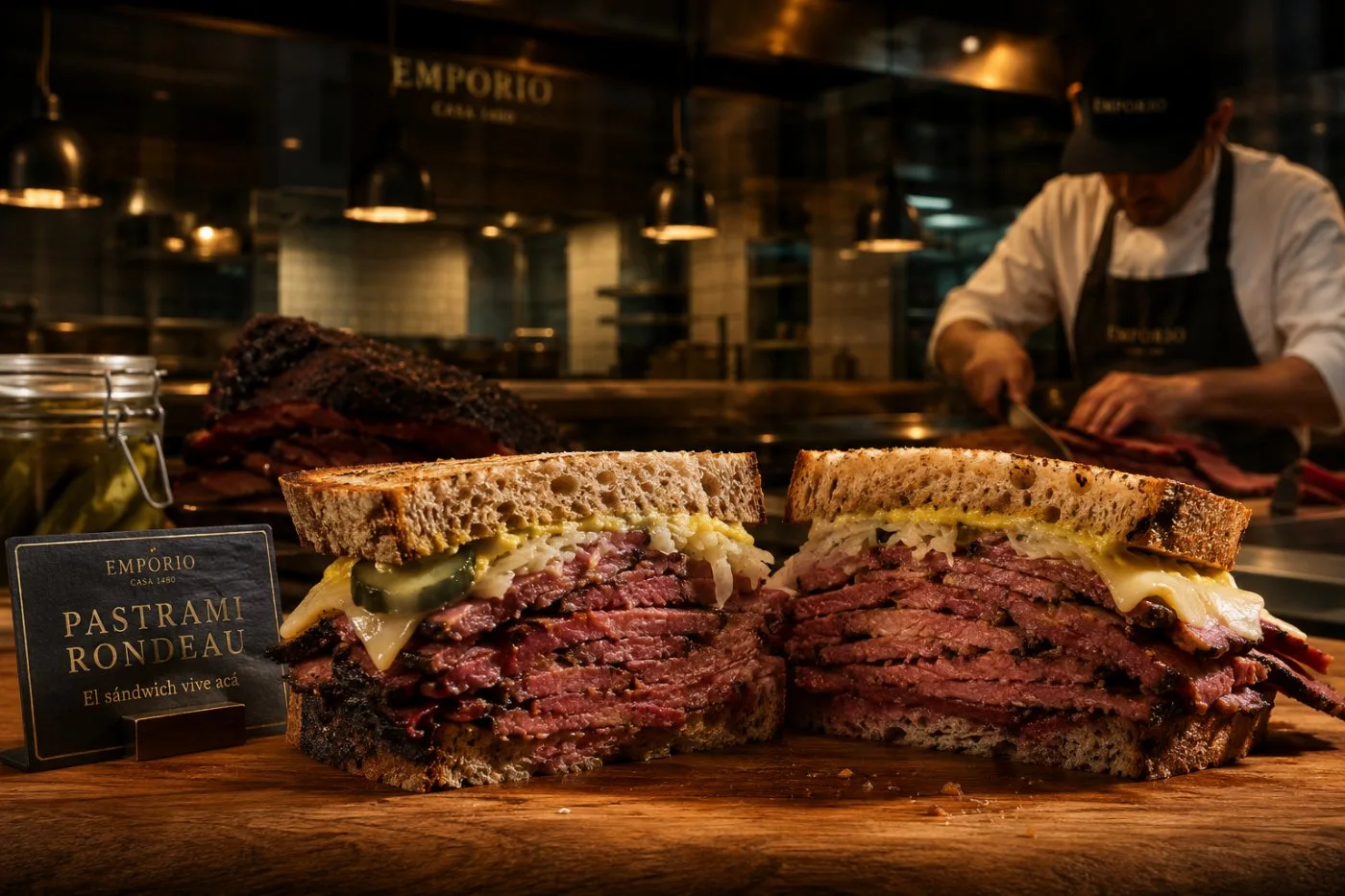
Rye sourdough, pastrami finished in-house and sliced hot, Swiss cheese, mild sauerkraut, pickles, honey-horseradish mustard, and house Russian dressing. The slicing must be visible. Some gastronomic activities create hunger through sound. Cutting hot meat in front of a line belongs in that category.
“It requires two hands. We recommend canceling any plan that calls for elegance.” |
4. The Chivito de Miga
A Uruguayan brand should not limit itself to importing the repertoire of Milan, New York, and Palermo. It must produce something others cannot copy with the same authority.
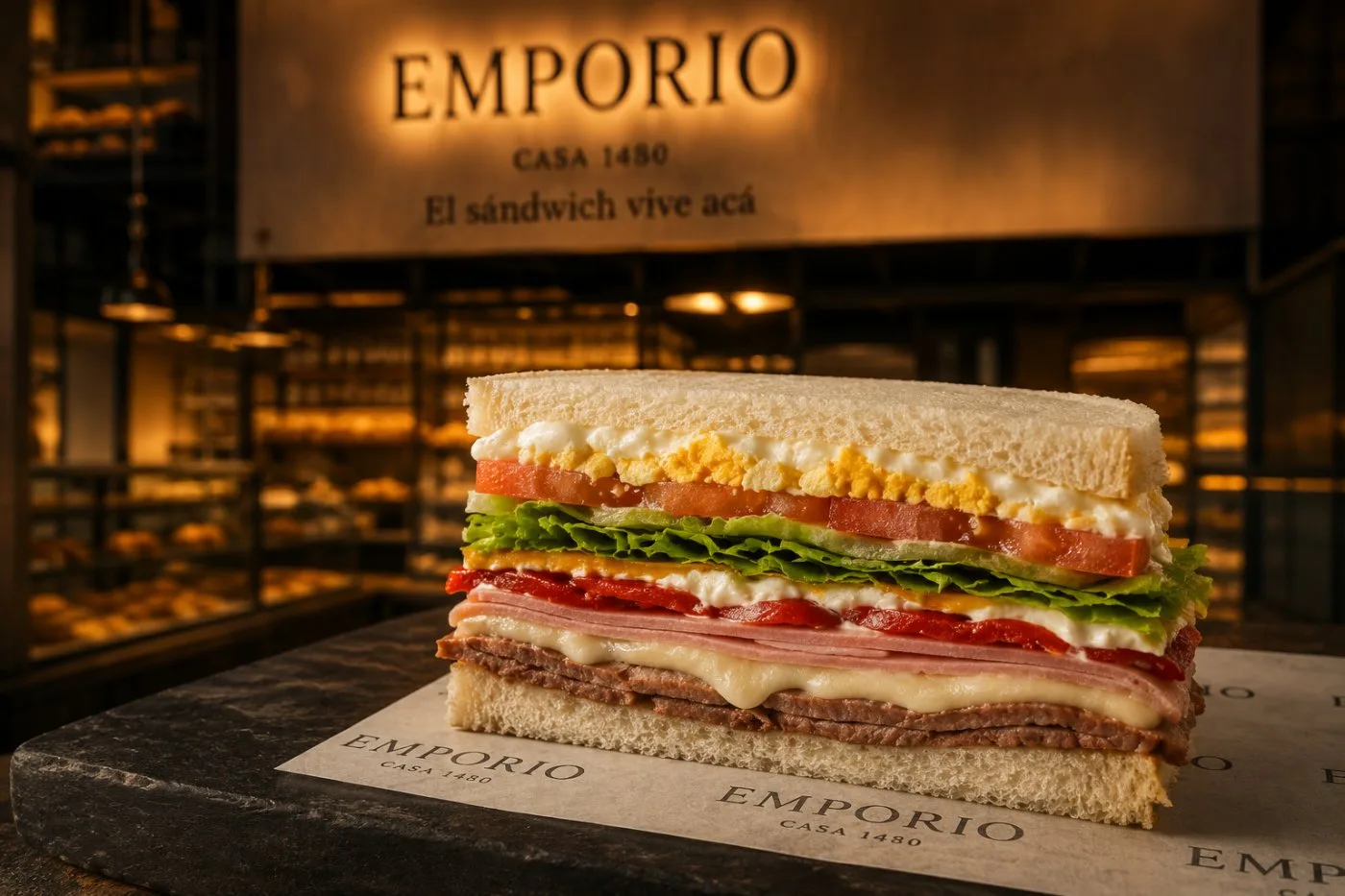
Three layers of lightly toasted sandwich bread, thin-sliced tenderloin, ham, mozzarella, egg, tomato, crisp lettuce, roasted bell pepper, and house mayonnaise. It is not designed as a tower that forces the customer to dislocate their jaw. It is designed as a precise, geometric, portable chivito.
“All the chivito. No need to shower afterward.” |
5. The Fainá Melt
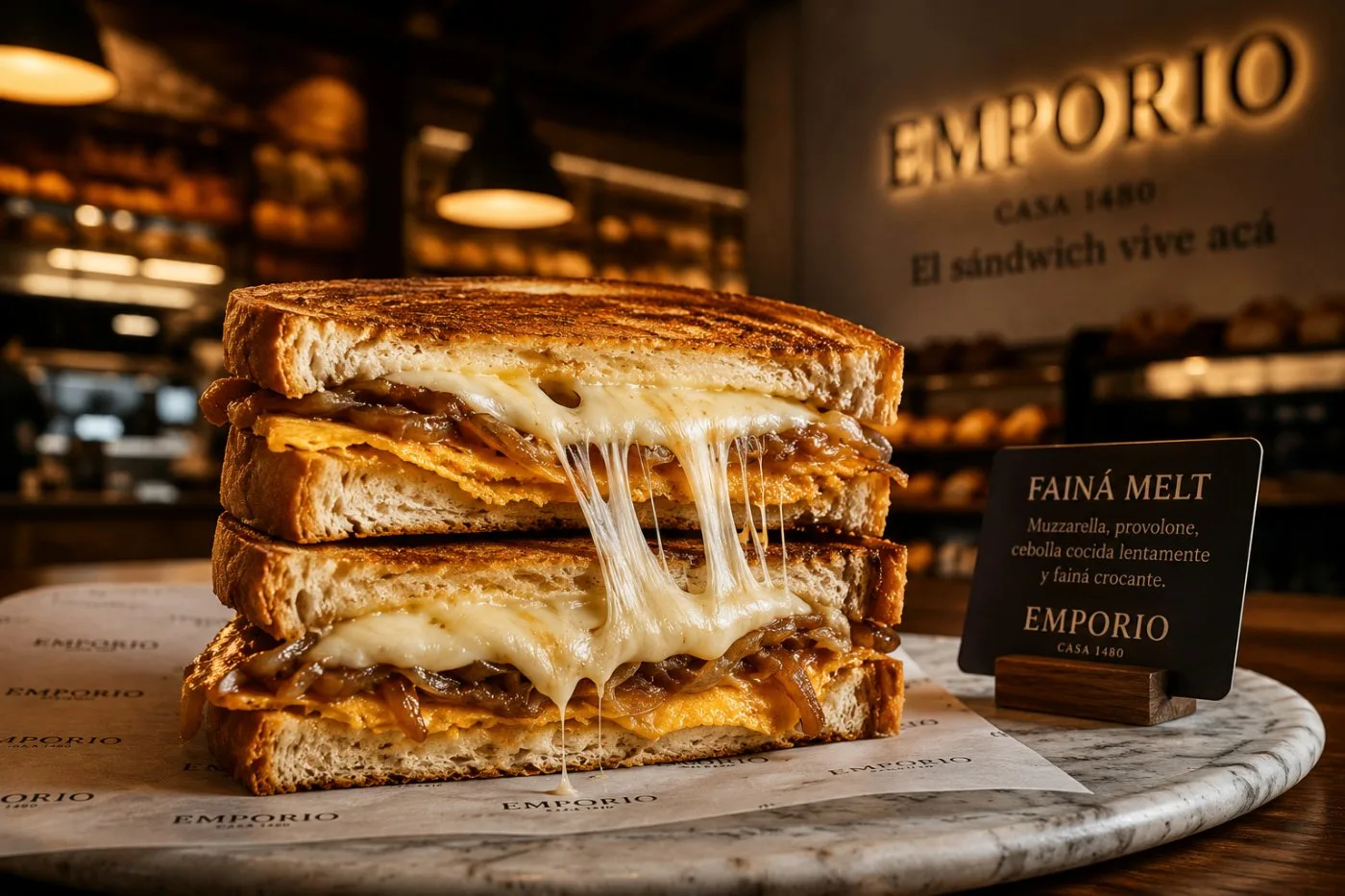
This could be the product no one expects and everyone talks about. Golden bread, mozzarella, provolone, slow-cooked onions, a thin crisp layer of fainá, black-pepper mayonnaise, and lemon.
The fainá does not appear as a side dish. It is the central texture. A grilled cheese exists in every city. A sandwich that incorporates fainá as a crisp layer can belong unmistakably to Montevideo.
“A grilled cheese that obtained Uruguayan citizenship.” |
6. The Sunday Milanesa
Potato roll, thin beef milanesa cooked in batches, provolone, seasoned tomato, lettuce, pickled onion, parsley-garlic-lemon mayonnaise, and shoestring potatoes. The milanesa cannot sit behind glass waiting for forty minutes. It comes out in visible batches.
“It tastes like Sunday. It works remarkably well on Wednesdays.” |
7. Tannat-Braised Pork Shoulder
Country bread, pork shoulder slowly cooked with Tannat, Colonia cheese, roasted onions, whole-grain mustard, and fresh cabbage. A sandwich capable of traveling beyond Uruguay without becoming an imitation.
“The pork shoulder spent several hours in Tannat. It is going through an excellent phase.” |
8. The Oriental Garden
The vegetarian product cannot look like a punishment. Focaccia, roasted squash, whipped ricotta, Colonia cheese, walnuts, arugula, pickled onion, gremolata, and hot honey.
“It contains no meat. It does not need to apologize either.” |
9. Port Tuna
Savory brioche, quality tuna, lemon mayonnaise, egg, capers, finely sliced celery, pickled onion, and crisp leaves. It must not taste like a diplomatic tuna paste. It must preserve texture.
10. The Grown-Up Francesito
The francesito should not be abandoned while Italian names are being imported. It should be elevated. A larger individual version, with enriched bread, ham, cheese, and a hot finish. The traditional product remains available in lunch-spread format. The Grown-Up Francesito becomes its street version.
“It grew up. We are processing it too.” |
VIII. CULT PASTRY
The best chocotorta in the world
Yes. Emporio should declare that it intends to make it. Not because it can mathematically prove it is the best. No international court is certifying layers of Chocolinas. It should do so because the claim is understandable, provocative, debatable, easy to remember, capable of crossing the Río de la Plata, and big enough to force the product to live up to it.
“Argentina invented chocotorta. Uruguay decided to audit it.” |
The 48-Hour Chocotorta
Between twelve and fourteen thin layers. Chocolate cookies selected through blind testing or specially developed. Controlled moistening with coffee, cocoa, and a minimal amount of salt. A mixture of pastry dulce de leche and cream cheese with enough acidity. One very thin central layer of bittersweet ganache. A true 48-hour rest. Cocoa on top. Crisp texture added at service. Defined serving temperature. A tall, straight, recognizable slice.
It should contain no gold, flowers, macarons, five sauces, a guilt-driven raspberry, or ingredients designed to prove the pastry chef went to Europe. The ambition is to create the definitive version of chocotorta, not to prevent people from recognizing it.
The Chocotorta World Cup
For eight weeks, Casa 1480 presents head-to-head contests between two formulas. More or less cream cheese. Coffee or cocoa. Classic cookie or house-made cookie. Ganache or no ganache. Twelve or fourteen layers.
Customers buy a tray with two small portions identified only as A and B. They vote through a code. Results are displayed in real time. Participants include customers, Uruguayan pastry chefs, Argentine guests, food journalists, and ordinary people who understand chocotorta because they have eaten approximately the body weight of a teenager in it.
The final is streamed live. The winner remains on the menu under the name “The Best Chocotorta in the World,” with the subtitle: “Selected through a process far more serious than the situation required.”
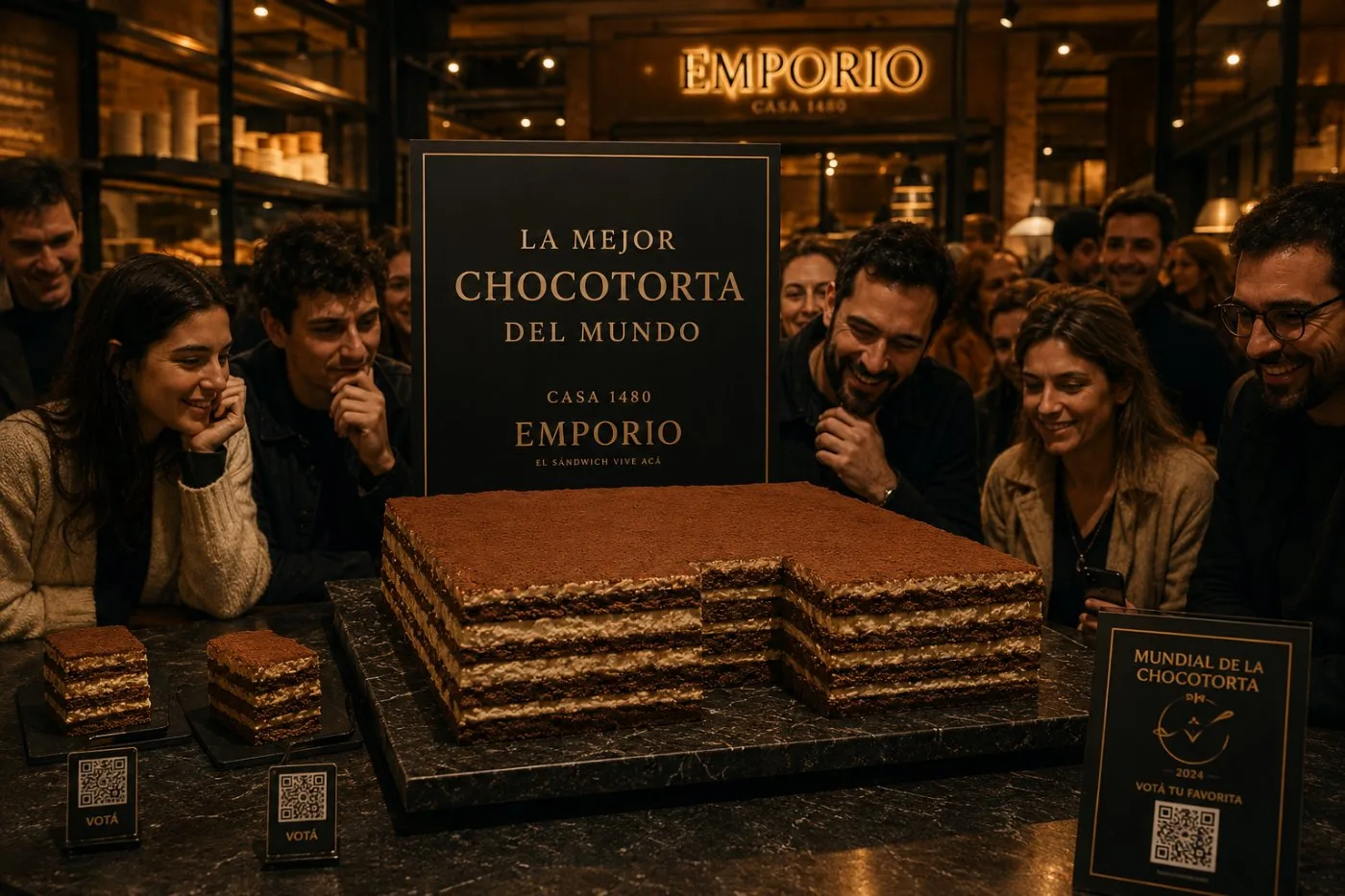
The Chocotorta World Cup: the product becomes competition, participation, repetition, and news.
Espuma de Mar Reborn
Emporio already has a dessert of its own. It would be a strategic crime to ignore it while searching for borrowed icons. The solution is not to replace it, but to give it two lives: The Original, preserving the classic recipe and presentation; and The Wave, a contemporary individual version finished in front of the customer.
“The dessert your grandmother used to eat. Now your grandmother wants to try this version.” |
The Impossible Mille-Feuille
Eighteen thin layers, dulce de leche, a minimal amount of cream, sea salt, toasted meringue, a tall cut, and plenty of napkins. The point is not to make it big. The point is to make it recognizable from another table.
“Eighteen layers and no instructions for eating it with dignity.” |
Rondeau Ricotta Cake
Thin sablé crust, well-drained ricotta, vanilla, lemon, an almost imperceptible layer of dulce de leche, and a lightly brûléed surface. Not a copy of another reference, but a Uruguayan answer to the principle that a business can build a pilgrimage around one extraordinary cake.
The Burnt Dulce de Leche Roll
Fermented dough, cinnamon, butter, a dulce de leche center, cream-cheese glaze, and a surface caramelized to order. Sold warm in batches.
“It comes out hot. Your good intentions, less so.” |
The Ultimate Birthday Cake
Moist chocolate sponge, dulce de leche, vanilla cream, a crisp layer, ganache, meringue, and candles included. The cake that looks like the memory of a childhood birthday executed by adults who learned technique.
IX. HOW TO CREATE LINES ALL DAY
A single limited release at one specific time does not solve the business. It creates a line before launch and an empty store several hours later. The day must be designed as a succession of small premieres.
TIME SLOT | STAR | MECHANISM |
7:30–10:30 | The oven | Mixtos, rolls, croissants, and focaccias in batches |
11:30–15:00 | The great sandwiches | Whole, halves, duos, and tasting |
15:30–18:00 | The sweet cut | Chocotorta, mille-feuille, and ricotta cake cut in public |
18:00–close | Pre-gathering and celebration | Boxes, trays, pickup, and orders to share |
The line must be the consequence of something always coming out, not of slow service. A line caused by inefficiency is an operational failure with an audience. A line caused by desire is a brand.
X. THE BOX THAT ARRIVES BEFORE THE HOST
The Emporio Box should open and transform into a serving tray. The host should not be forced to transfer thirty pieces while guests watch them progressively lose the will to live.
The design includes two fold-out levels, a flavor map, temperature instructions, preparation time, occasion name, a code to repeat the order, a referral code, and clear identification of vegetarian items and allergens.
“Open when everyone is watching.” |
The box must be recognizable in a photograph without the logo covering the entire surface. The best packaging does not ask to be photographed. It makes photographing it feel like a normal reaction.
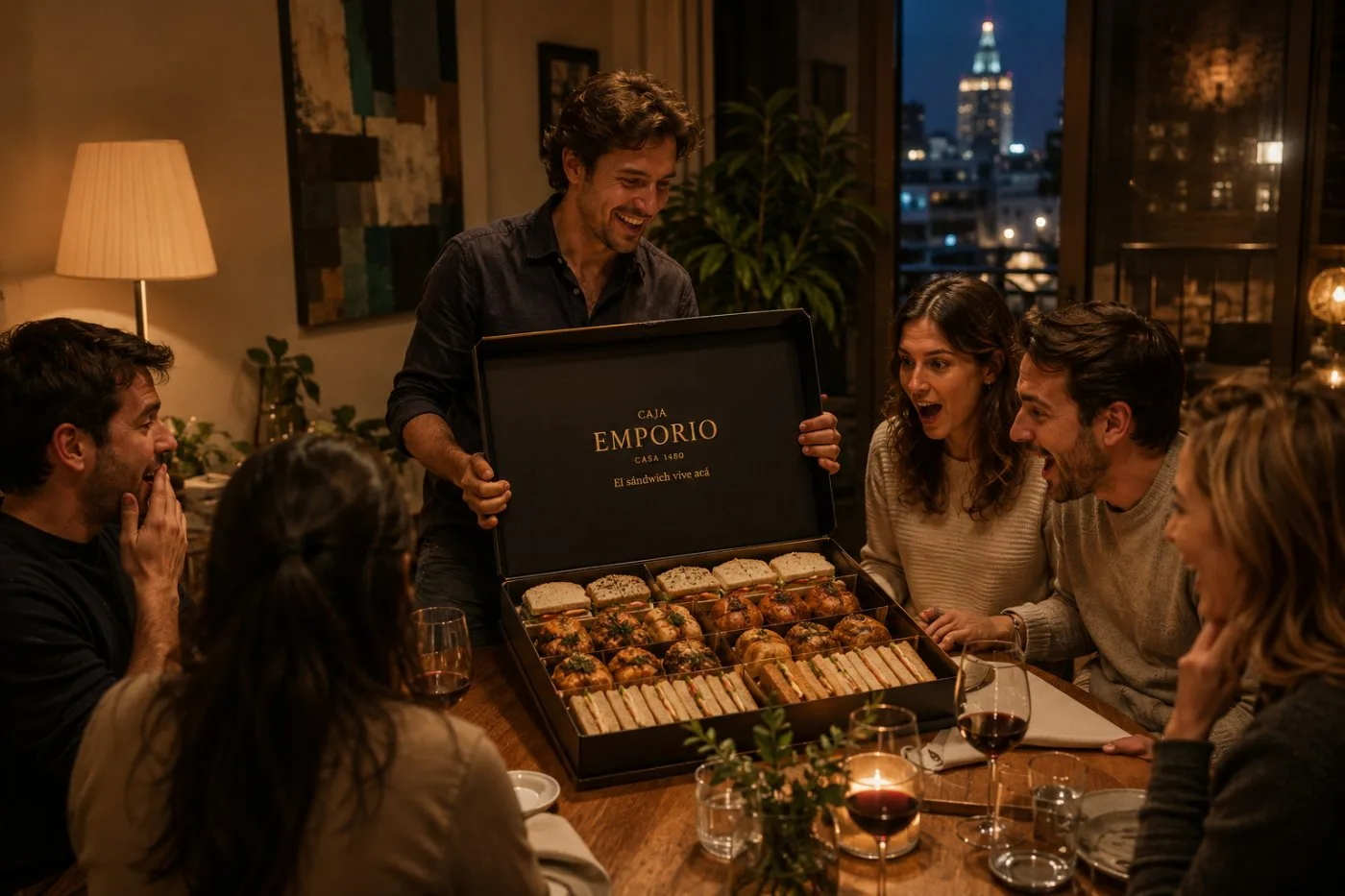
The Emporio Box: it does not merely deliver food. It enters the gathering as a scene and gives the host back their peace of mind.
XI. THE STORES SHOULD NOT BE COPIES
The current network is an advantage, but only if each location has a mission. The mistake would be to remodel every store so they look alike, serve the same menu, and repeat the same sign. A coherent brand does not need identical locations. It needs a shared promise and distinct roles.
Casa 1480: the heart and laboratory
1480 Rondeau should be the place that explains the entire system. Visible production, pastrami slicing, focaccia coming out, sandwich-bread assembly, dessert finishing, Chocotorta World Cup trials, a tasting table, historical archive, launches, and workshops.
During renovation, the sign should read: “Closed due to excessive habit.” Underneath: “We will return when the sandwich once again justifies the name.” This does not announce new paint. It announces a new standard.
Tres Cruces Terminal: the last great sandwich before the trip
The terminal location serves people with luggage, urgency, and a destination. It should not try to be Casa 1480 in miniature. It should be the country's best travel-sandwich system, with one concrete promise: order in hand in under five minutes.
Its exclusive product would be The Traveler: a compact chivito-inspired sandwich designed to travel without falling apart. The menu should have five products. The customer has a bus to catch. They are not defending a thesis.
Tres Cruces Shopping: the gateway to the brand
It should offer half-sandwich tastings, chocotorta, classics, coffee, and a Uruguay Box with small versions inspired by chivito, fainá, Tannat-braised pork, and sandwich bread, plus a portion of Espuma de Mar.
Nuevocentro: neighborhood frequency
It should be the repeat-visit store: breakfast, lunch, afternoon snack, quick ordering, and small gatherings. Here the priority is fixing operational flow before adding spectacle. One person serving a full café is not efficiency. It is a negative review waiting for an internet connection.
Portones: the east-side premium laboratory
It should concentrate Mortadella, Oriental Garden, Pastrami on selected days, coffee, corporate boxes, and fast pickup. Before becoming a premium showcase, it must become a flawless operation. A premium price does not buy patience. It buys certainty.
Costa Urbana: the family and sweets location
It can become the major location for afternoon snacks, cakes, birthdays, family boxes, and weekends. The priority is proving the new strategy is not cosmetic: a short display case, frequent cutting, finishes performed in view, and five sweet products no one regrets choosing.
Las Piedras: the home of popular celebration
It should not receive an impoverished version of the concept or a menu designed for another area. It must understand large birthdays, family gatherings, clubs, community celebrations, volume orders, and perceived value. Once a quarter, neighbors and businesses submit recipes. The winner is sold for one month. Community is not built by posting “we are community.” It is built by sharing power.
XII. THE NATIONAL SANDWICH CHAMPIONSHIP
Emporio can become the institution that organizes the national conversation about the sandwich. Nineteen departments. Nineteen recipes inspired by local ingredients, customs, and stories.
Canelones: pork shoulder, Tannat, and onion.
Colonia: Colonia cheese, ham, and mustard.
Rocha: fish, lemon, and herbs.
Salto: citrus, pork, and heat.
Montevideo: Fainá Melt.
The competition would include recipe submissions, regional selection, temporary sales, public voting, and a final at Casa 1480. The winner remains on the menu for one year. Emporio stops being a chain that sells sandwiches and becomes the institution that records and celebrates how Uruguay eats sandwiches.
XIII. THE CRUMB CLUB
Not a points program. Not a card requiring eleven purchases, three stamps, a full moon, and the manager's signature to hand over a coffee. A system of belonging.
Free entry
A person joins after trying three New Icons within 45 days, buying an Emporio Box and referring a new customer, or participating in four chocotorta contests. The brand rewards behavior and curiosity, not spending alone.
How membership is maintained
Access is maintained by making a purchase or participating in an activity every 120 days. With no activity, the member returns to the general level. A permanent privilege for an absent person stops being a privilege. It becomes an old database.
What the member receives
Advance reservations for limited products.
Access to the secret sandwich.
One quarterly tasting.
The ability to vote on new products.
Priority for the Chocotorta final.
A digital history of products tried.
A pickup line that is genuinely faster.
A special portion on their birthday.
Invitations to Crumb Night.
They do not receive permanent discounts. The main benefit is access. When all loyalty is purchased with markdowns, the brand trains the customer to wait for the next discount.
Table 1480
A paid membership for the most committed followers. Design price: $1,480 per year during the first year, with 1,480 founding members. It is a hypothesis to validate, not a demand estimate.
Four tastings per year.
Reservation 24 hours in advance.
An exclusive anniversary box.
Two admissions to the tasting menu.
Priority invitations to launches.
A numbered metal token.
The right to propose one recipe per year.
Name in the founders' digital archive.
The value is not in giving away food equal to the membership fee. It is in turning the customer into a witness to and participant in the revival.
XIV. THE GUARANTEE THAT FORCES THE COMPANY TO RESPECT ITSELF
Fresh or Remade Guarantee
Every high-turnover product carries its preparation time, latest sale time, batch, and location. If the customer receives a dry, stale, or out-of-spec product, it is replaced immediately. There is no argument. No oral defense is requested. No small trial is convened around a croissant.
A product that exceeds its window does not return the next day disguised by heat. It is removed. Waste hurts. It should hurt. That pain forces better forecasting. A system that avoids all waste usually transfers the cost to the customer in the form of old bread.
Event guarantee
“Complete, fresh, and on time.” |
If part of the order is missing, the replacement leaves immediately. If a delivery misses the agreed window due to company responsibility, the delivery fee is refunded and compensation is credited. The promise is not that an error will never occur. The promise is that the error will not be left living in the customer's home.
XV. THE WEBSITE MUST STOP LOOKING LIKE A WAREHOUSE
A store with hundreds of items can be useful to someone who knows exactly what they want. For a new customer, it is an interrogation. The home page should begin with five choices: I want to try Emporio; I want lunch now; I want to take something sweet; I am hosting people; I need an order for my company.
Then it asks how many people, when, budget, restrictions, and pickup or delivery. The system recommends. It does not abandon the customer in front of a crowd of sandwiches in the hope they spontaneously develop the skills of a gastronomic curator.
The live screen
What is coming out now.
How many units remain.
Estimated time.
Exclusive products.
Next batch.
Ability to reserve.
The first conversion
Watch a cut.
See what is coming out nearby.
Reserve a tasting.
Try it.
Vote.
Return.
Buy a box.
Bring Emporio into the company.
Become a member.
Invite someone else.
Lines are not born from a campaign. They are born from a succession of small “yeses.”
XVI. THE VOICE
The brand should not speak like a century-old institution asking permission to be likable. It must speak with dry humor, confidence, and affection. Without turning into a teenager hired to post memes.
For ten people: thirty pieces. For ten people saying they are not hungry: forty-five. |
We arrive before the guest who texted, “I am leaving now.” |
It sold out. We are grieving too. |
We cannot choose your relatives. We can choose the menu. |
You may share it. Technically. |
The chocotorta rested for 48 hours. You will not be able to wait eight minutes. |
The recipe is seventy years old. The sandwich is not. |
XVII. THE COMEBACK CAMPAIGN
“Emporio is making sandwiches again”
It is a dangerous sentence. That is why it works. It does not mean the company had stopped producing them. It means it will once again treat each one as though the company's name depended on it.
“For years, we kept doing more and more things. One day we understood that variety is not the same as desire. We are called El Emporio de los Sándwiches. It was time to deserve the name again.” |
The reopening of Casa 1480
During construction: “Closed due to excessive habit.” Upon reopening: “We are back to making a few things that are impossible to forget.”
Week one: invitation to longtime customers and trials of The Everlasting.
Week two: the start of the Chocotorta World Cup.
Week three: launch of Pastrami Rondeau.
Week four: the first Crumb Night.
The campaign does not explain that the lighting changed. It shows products, cuts, lines that move, and people arguing over which version wins.
XVIII. THE OPERATION THAT MAKES DESIRE POSSIBLE
This strategy cannot be launched on top of an inconsistent operation. The result would be an enormous campaign designed to help more people discover the same problems more quickly.
Reduce before adding
The catalog is classified into hero products, classics and events, and the long tail. Between fifteen and twenty hero items must be visible, trained, and measured obsessively. Low-turnover products must prove profitability, relevance, or historical value. If they satisfy none of the three, they leave.
“Having hundreds of items is not always generosity. It can also mean no one wanted to have the difficult conversation.” |
Central production, local finishing
The flagship kitchen can produce bases and components. The stores need to finish focaccias, hot sandwiches, rolls, cuts, brûléed items, and assembly. The customer must perceive activity. A brand that wants to create lines cannot hide all the magic in a plant and send only the refrigerated corpse of the process to the store.
Sensory specifications
Weight.
Temperature.
Moisture.
Amount of filling.
Maximum holding time.
Reference photograph.
Assembly sequence.
Dispatch time.
Not to turn employees into robots. To prevent every shift from improvising a different version of the myth.
Staffing
During critical hours, roles must be clear: who receives, who assembles, who finishes, who hands over, and who resolves errors. One person serving a full café is not efficiency. It is a negative review waiting for an internet connection.
XIX. PRICE
Emporio should not become cheap. Nor should it assume that premium means adding pistachios and raising the price. Price must reflect product, technique, freshness, presentation, service, and reliability.
Design hypotheses to validate
ENTRY POINT | INITIAL RANGE |
Half sandwiches | $190–$350 |
Tasting duos | $390–$590 |
Sweet portion | $280–$390 |
Whole sandwich | $390–$690 |
The figures are testing hypotheses, not market data. The entry point must allow someone to try the brand without organizing a gathering or seeking approval from the family board of directors.
Boxes should be organized by number of people and occasion: Box 4, Box 8, Box 12, and Box 20, at Classic, Icon, and Grand Table levels. Not by an itemized list the customer studies like a probate inventory.
XX. THE FIRST NINETY DAYS
Days 0 to 30: stop lying to ourselves
Mystery-shop every location at different times.
Measure moisture, temperature, amount of filling, appearance, service, and speed.
Classify the catalog by sales, margin, repeat purchase, waste, complaints, and historical value.
Blind-test current classics against improved prototypes.
Create multiple versions of the Mixto, focaccia, Fainá Melt, Chivito de Miga, chocotorta, and Espuma de Mar.
No product enters because people “liked it.” It must achieve an average above 8.5 out of 10, repurchase intent above 60%, the ability to be recalled the next day, and consistency across three different batches.
Days 31 to 60: build Casa 1480 without waiting for the final renovation
Create a visible laboratory inside the existing operation.
Pilot the Perfect Mixto, Mortadella, Fainá Melt, Pastrami Rondeau, Chocotorta A/B, and Espuma de Mar Reborn.
Invite longtime customers, young people, neighbors, cooks, and people who stopped buying.
Open a waitlist with an initial goal of 1,480 registrations.
Metrics: 70% of each batch sold in under one hour; 25% repeat within thirty days; fewer than five quality complaints per thousand products; average handoff below eight minutes; 30% of sales made up of duos or tastings.
Days 61 to 90: ignite the first line
Week one: The Everlasting and four New Icons.
Week two: the first Chocotorta World Cup matchup.
Week three: the Crumb Club.
Week four: the first Crumb Night.
Controlled expansion of one exclusive product to each location according to its mission.
The signal is not seeing twenty people on the street one afternoon; the register may simply have broken. The real signal combines a visible line, reasonable wait, product selling out within forecast, customers returning, advance reservations, and no deterioration in quality under pressure.
XXI. THE RISKS
“Longtime customers will get angry”
Some will. There is always someone who considers changing the thickness of the bread a personal attack. That is why The Everlasting remain. The new line does not replace memory. It surrounds it with a future.
“The new products are expensive”
The problem is not only the number. It is whether the customer understands why it exists. A sandwich without story, presentation, or execution looks expensive. One worth traveling for, cut in front of the customer, and delivering on its promise can feel like a reward.
“They will copy us”
They will copy the mortadella. They cannot easily copy ninety years, Casa 1480, Espuma de Mar, the store network, the National Championship, the community, the recipe archive, the launch system, and the cultural authority earned. The moat is not the ingredient. It is the ecosystem.
“We cannot do everything”
Correct. That is why not everything is done. Casa 1480 comes first. Then it is proven. Then it is distributed. Ambition does not require simultaneity. It requires sequence.
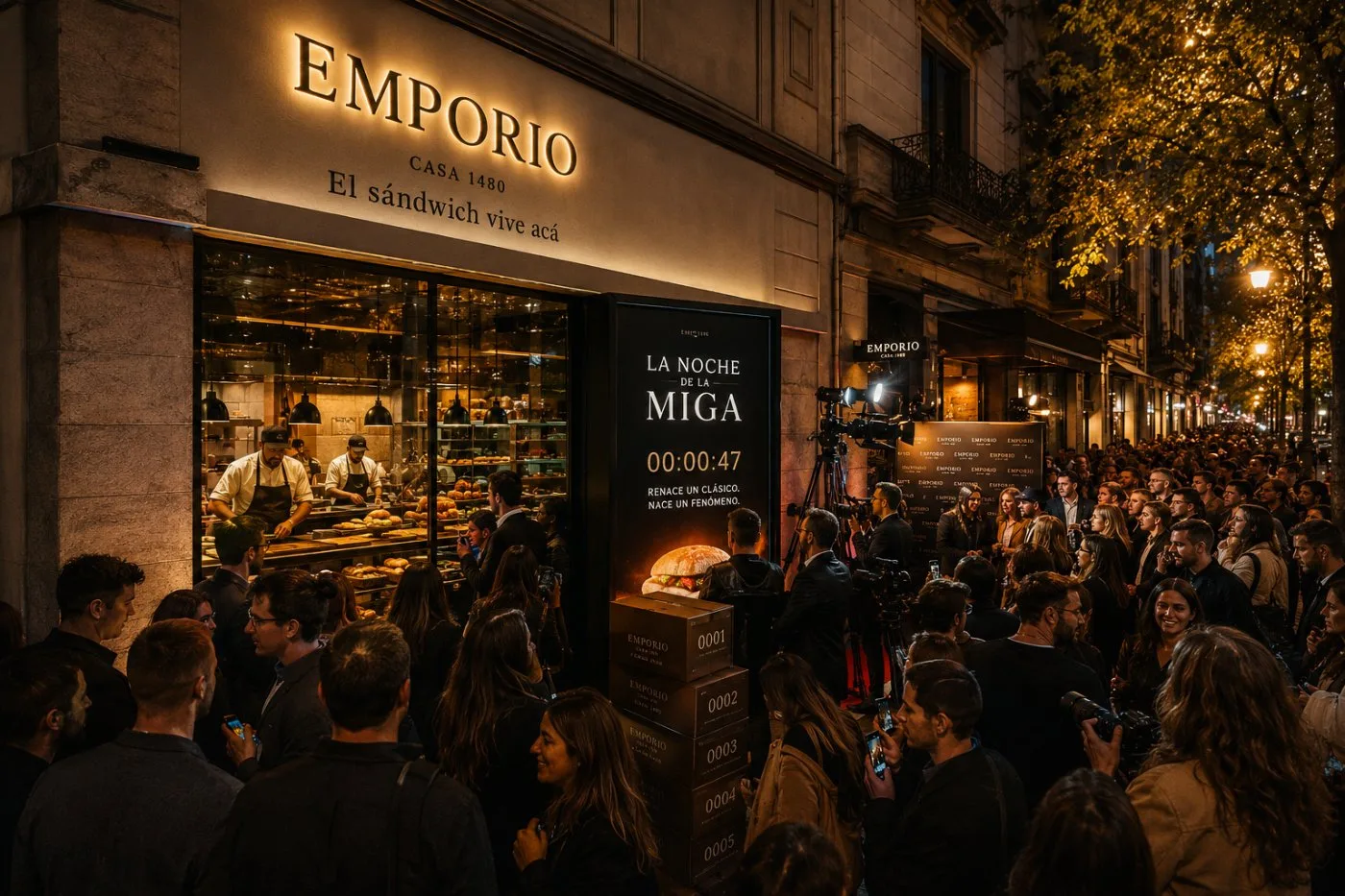
THE VERDICT
Emporio possesses something almost no company can buy: a name that already dominates the category, a ninety-year history, and a physical place capable of becoming a myth.
But history does not create lines when it is used as a certificate of survival. It creates them when it becomes permission to do something a newborn brand would not dare attempt.
Emporio does not need another promotion, forty more varieties, or another café that looks like every other one. It needs products people can name, stores with distinct missions, freshness that can be verified, humor that can be repeated, and events that make Montevideo look at the clock and think: “It is about to come out.”
“A line that forms because the system is slow is a failure. A line that forms because each person knows what they came to get is a brand.” |
Because a ninety-year-old brand has no right to live off memory.
IT HAS AN OBLIGATION TO MAKE PEOPLE HUNGRY AGAIN. |
ARIEL PFEFFER Architect of Desire arielpfeffer@gmail.com LIFE REWARDS ACTION! I design desire. I work on a limited number of mandates each year and accept only those where there is a structural question worth investigating, sufficient access, and a real capacity to act. |
Public sources consulted
"Our story" — El Emporio de los Sandwiches (official site). Consulted in August 2026.
"Branches and opening hours" — El Emporio de los Sandwiches (official site). Consulted in August 2026.
Sandwich catalogue — El Emporio de los Sandwiches (official site). Consulted in August 2026.
"90 years" promotion terms — El Emporio de los Sandwiches (official site). Consulted in August 2026.
Customer reviews — TripAdvisor. Consulted in August 2026.
"Where to eat sandwiches: classic restaurants, bars and focaccias" — Time Out Buenos Aires. Consulted in August 2026.
Primary sources from the official site, press and customer reviews. The interpretations in this analysis are Ariel Pfeffer's.
A ninety-year-old brand has no right to live off memory. It has an obligation to make people hungry again.
Celebration is a market. Craving is a frequency.
Having hundreds of items is not always generosity. It can also mean no one wanted to have the difficult conversation.
The verdict
What it cannot say today with indisputable authority is: “This is the sandwich worth crossing Montevideo for.”
What would an autopsy of your business say?
Every new autopsy reaches the list first: the short version, the key finding and a few extra things I don't publish anywhere. No spam, no discounts, no "last chance".
Get the autopsies before anyone else →