Autopsy Nº 02·Global
McDonald's - It's not a price issue
It is not about how much a combo costs. It is about what eating one means
- BRAND ANALYZED:
- McDonald's
- Industry
- Fast food
- Country
- United States
- Published
- August 3, 2026
In five lines
The poor are leaving and the rich are arriving. If this were a price problem, the opposite would be happening. What McDonald's sold was never food: it was certainty and speed without guilt. Anyone offers that today, and when you offer what everyone offers, all you have left is cutting the price. The brands taking its ground hand you an image of yourself; McDonald's tells you it is fast and cheap, two things about itself, not about you. Its greatest strength, being everywhere, is what kills any line: the clock has to become scarce, not the store.
FactAUTOPSIES OF DESIRE
FactDESIRE AUTOPSY · An independent diagnosis of replaceability and desire
FactAUTOPSY
McDonald's Is Losing the Poor
and Winning the Rich—and Thinks
It Is a Pricing Problem
Its lifelong customer is leaving. Its response was to lower prices. It is the wrong answer to the wrong question.
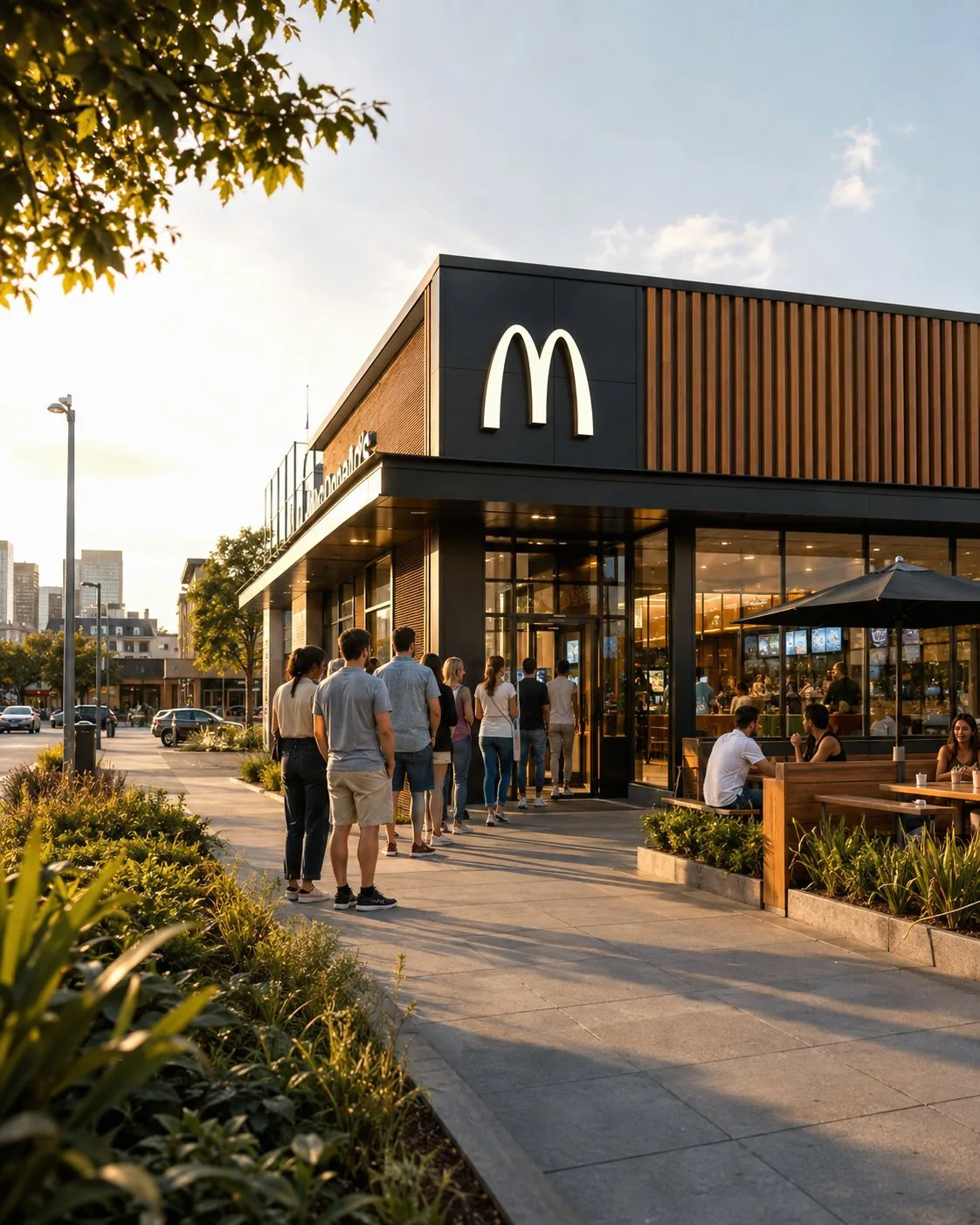
McDonald’s
Prepared by Ariel Pfeffer · arielpfeffer@gmail.com
Life Rewards Action!
I design desire. I work with a limited number of organizations each year to preserve the depth and independence of the diagnosis.
THE OPENING
The Data That Matters
“It is not about how much a combo costs. It is about what eating one means.”
There is a number in McDonald's latest financial results that should keep someone awake at night, and it is not the one the company keeps repeating. The one they repeat is that lower-income customers—the historic heart of the business—have been declining by nearly double digits for two years. They say it on every investor call, with a grave expression, blaming inflation. The number they do not say out loud is the other one, the one contained in the same sentence: while the poor are leaving, the rich are coming more than ever.
Stop there, because that combination is the entire diagnosis. People with no money are abandoning the cheap brand, while people with money are choosing to go. If this were a pricing problem, the exact opposite would happen. It is not about how much a combo costs. It is about what eating one means. And McDonald's, convinced that its problem is price, responds with the only tool it knows how to use: discounts. It is treating a wound of meaning with a money Band-Aid. That is why it does not add up, and why no one crowds at its door: people enter through the door of cheapness with resignation, not desire.
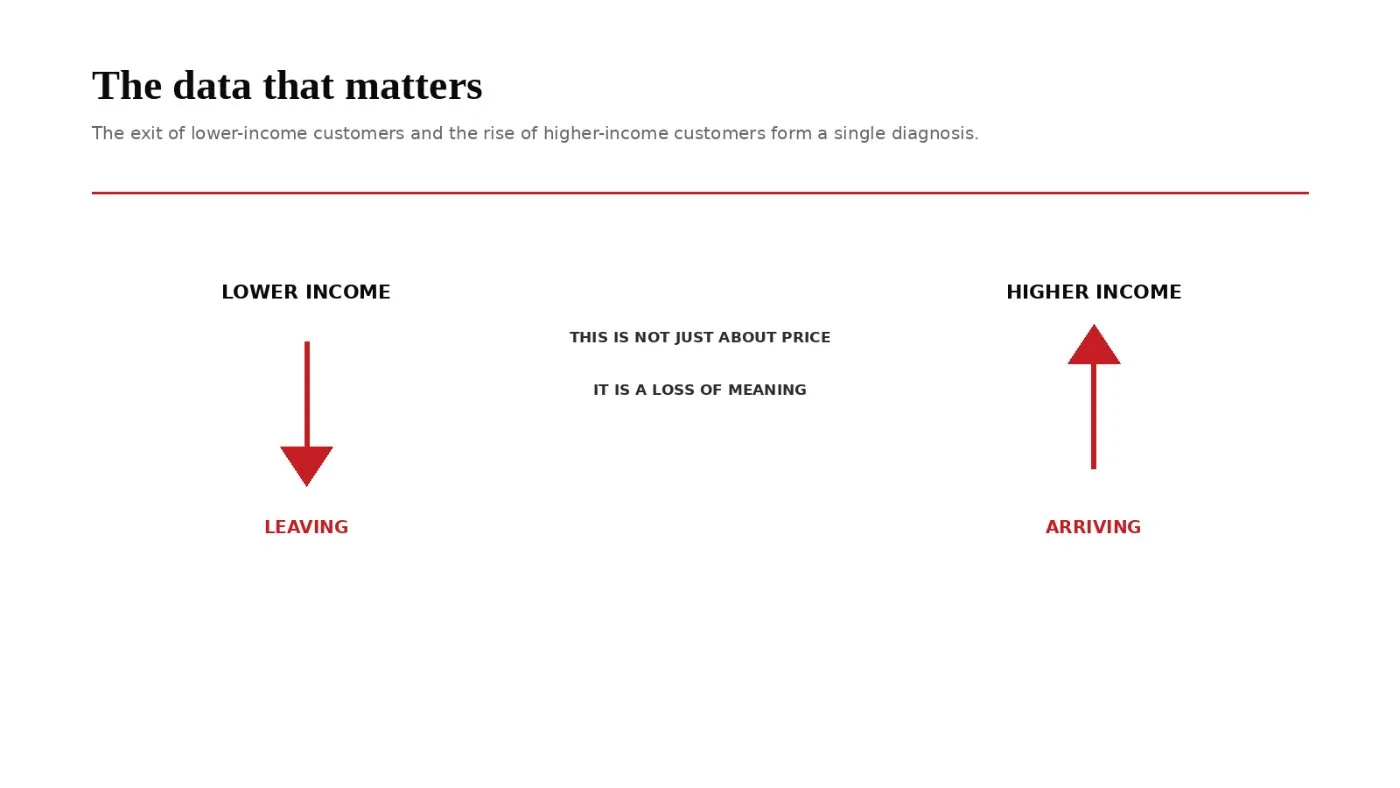
Two movements that seem opposite reveal a single problem: the brand stopped producing meaning.
THE CAUSE OF DEATH
What the Brand Still Did Like No One Else
Let us ask what people are looking for when they go to McDonald's, because it was never the food. No one in the history of the planet chose McDonald's because it made the best burger. What the brand sold was something else, and it was powerful: certainty and speed without guilt. You know exactly what you will receive, in any country, in four minutes, for little money, without thinking. For a parent with two screaming children in the back, that is not fast food: it is a rescue. That was the real job, and it did it like no one else.
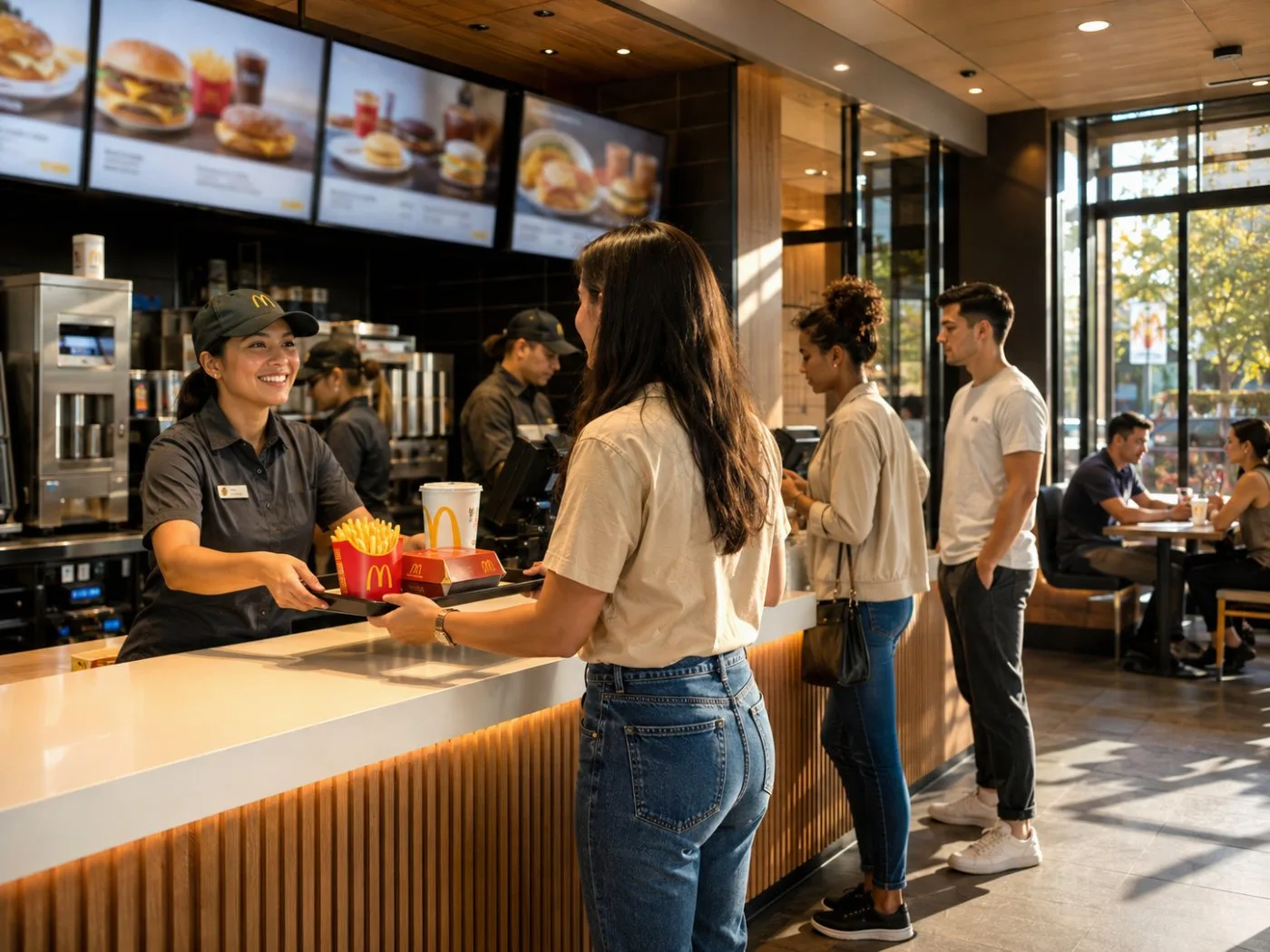
Certainty and speed remain real assets. The problem is that they are no longer exclusive.
The problem is that today anyone can do that job. Certainty and speed stopped being its privilege: the chain next door has them, the chicken chain has them, the delivery app has them. McDonald's remained reliable and fast in a world where that no longer distinguishes anyone. It is like continuing to sell “it has wheels” in the car business. Every car has wheels. And when you offer what everyone else offers, you are left with only one lever: price. That is why it ended up trapped by discounts. It is not a strategy; it is all that remained when the difference disappeared.
THE CAUSE OF DEATH
When a Brand Stops Reflecting an Image Back to You
A huge gap opened beside it. Burger brands appeared that sell something McDonald's does not: a feeling about yourself. When you eat at one of them, you do not buy a tastier burger; you buy the feeling that you are treating yourself well, that you have discernment, that you chose something with a story instead of what everyone eats. One premium chain literally calls its campaign “Worth It.” Listen to that phrase next to McDonald's. One brand says “this is worth it.” The other says “this is cheap.” Opposite promises, and it is no coincidence that the first keeps the people who can choose.
That is what McDonald's left on the table: making eating there feel good about yourself. Not better fed—good about yourself. The brands that took ground away from it reflect an image back to you: that you have good taste, that you care about what you eat, that you support things made by hand. McDonald's reflects no image of you. It tells you that it is fast and cheap, two things about them, not about you. A brand that reflects no image of yourself can be replaced without feeling anything, because you never felt anything.
“A brand that reflects no image of yourself can be replaced without feeling anything.”
And here is the silent humiliation they still cannot digest. The rich customer who enters today does not enter out of desire, but calculation: food is expensive everywhere, and McDonald's is the option that is least painful for the wallet this week. A passing customer, on loan from the economy, who will leave when conditions ease. And the poor customer, the truly loyal one, is leaving not only because of price, but because when something is all you can afford, you begin to hate it in silence. McDonald's stopped being “the place I want to go” and became “the place I settle for.” No line forms at the door of a place people settle for.
The real enemy, then, is not any chain. It is resignation: that sighing “fine, McDonald's,” the opposite of desire. You do not fight it by lowering the price. Lowering it confirms it: you tell the customer, “you are right, all I have is that I am cheap.” Every discount is a note that says, “I am worth no more than this.” No one waits standing up, no one crowds together, for something that apologizes for existing.
THE RESURRECTION
How to Create the Line—Every Day, Not Just Once
This is where the value lies, and I want to be brutal about the standard because this is where everything is decided. A line on launch Saturday is useless. Bringing in a celebrity is useless, because by the third time it becomes an expensive, predictable routine, and people can smell the maneuver. The line that matters is the one on a Tuesday at three in the afternoon for no special reason: people standing there waiting simply because it is worth it, every day. That one is permanent. That one sustains itself. And it is much harder, because no event ignites it: the structure of the business has to produce it.
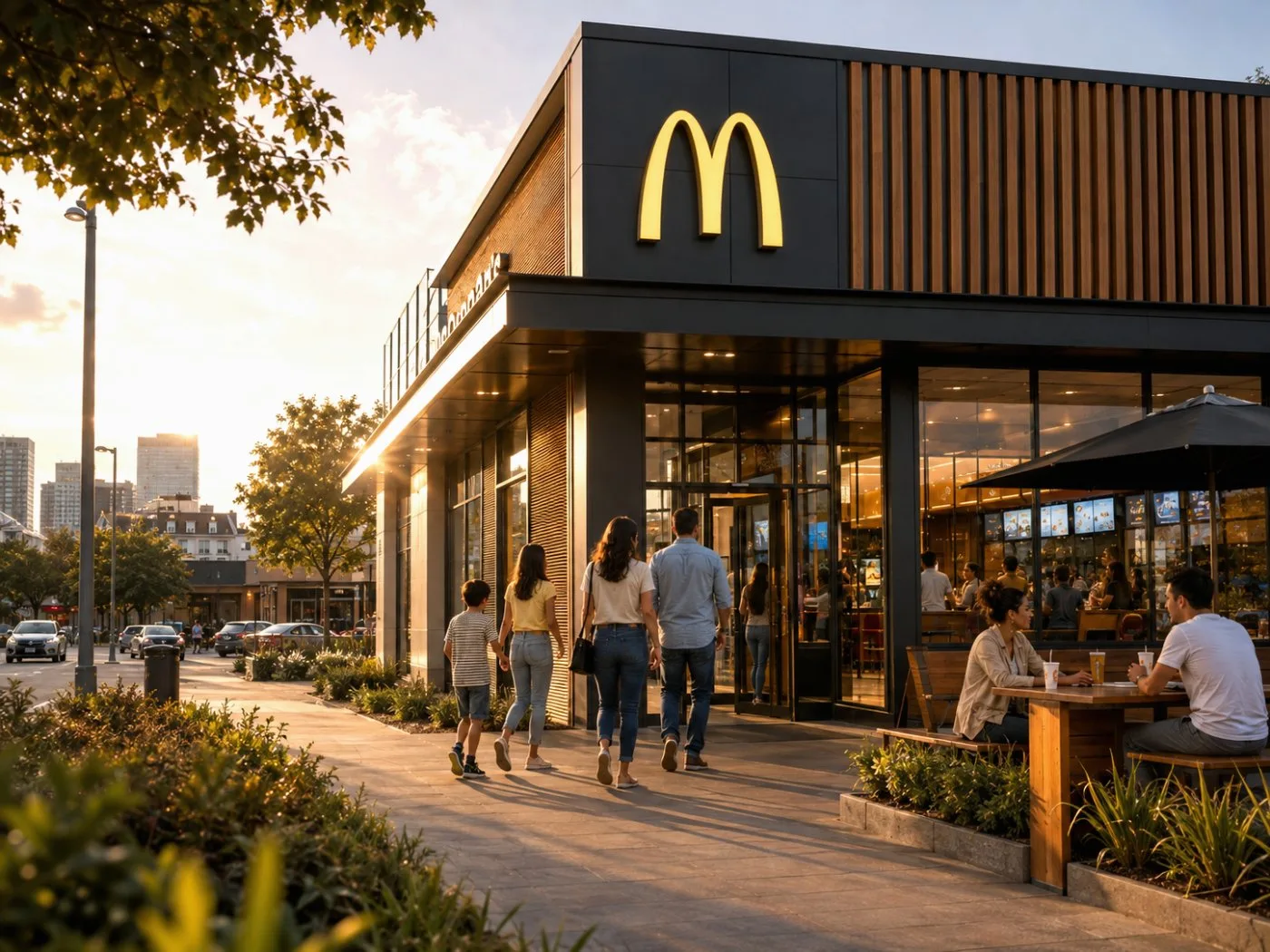
The proof is not a launch line. It is the line on an ordinary Tuesday, produced by the structure of the business.
And here is the wall that must be crossed, stated plainly. Cult venues with permanent lines have them because there are very few of them: scarcity of locations forces people to concentrate and wait. McDonald's is the opposite by design—so many locations that demand never gathers in any one of them. As long as there is an empty McDonald's four blocks away, no line is possible at the corner location. Ubiquity, its greatest strength, is the structural killer of any line. Any idea that ignores this is smoke.
THE RESURRECTION
Ubiquity as Problem and Weapon
That is why the answer cannot be to make McDonald's scarce in space—that would mean asking it to stop being McDonald's, and it is also impossible with 40,000 locations. The only answer is to move scarcity from space to time. Not fewer places. Fewer moments. That is the turn, and it is where no one in the industry is playing.
The big idea, without detours: McDonald's has to turn certain dead hours of the day into a daily event with a name, rules, and something that exists only in that window and disappears when the window ends. Not a product that is always there. A ritual that happens only at a fixed hour, every day, and if you are not there, you missed it until tomorrow. Scarcity stops being “few locations” and becomes “this hour and no other.” And McDonald's can do that across all 40,000 locations at once, because the clock is the only thing that can be scarce even when space is infinite.
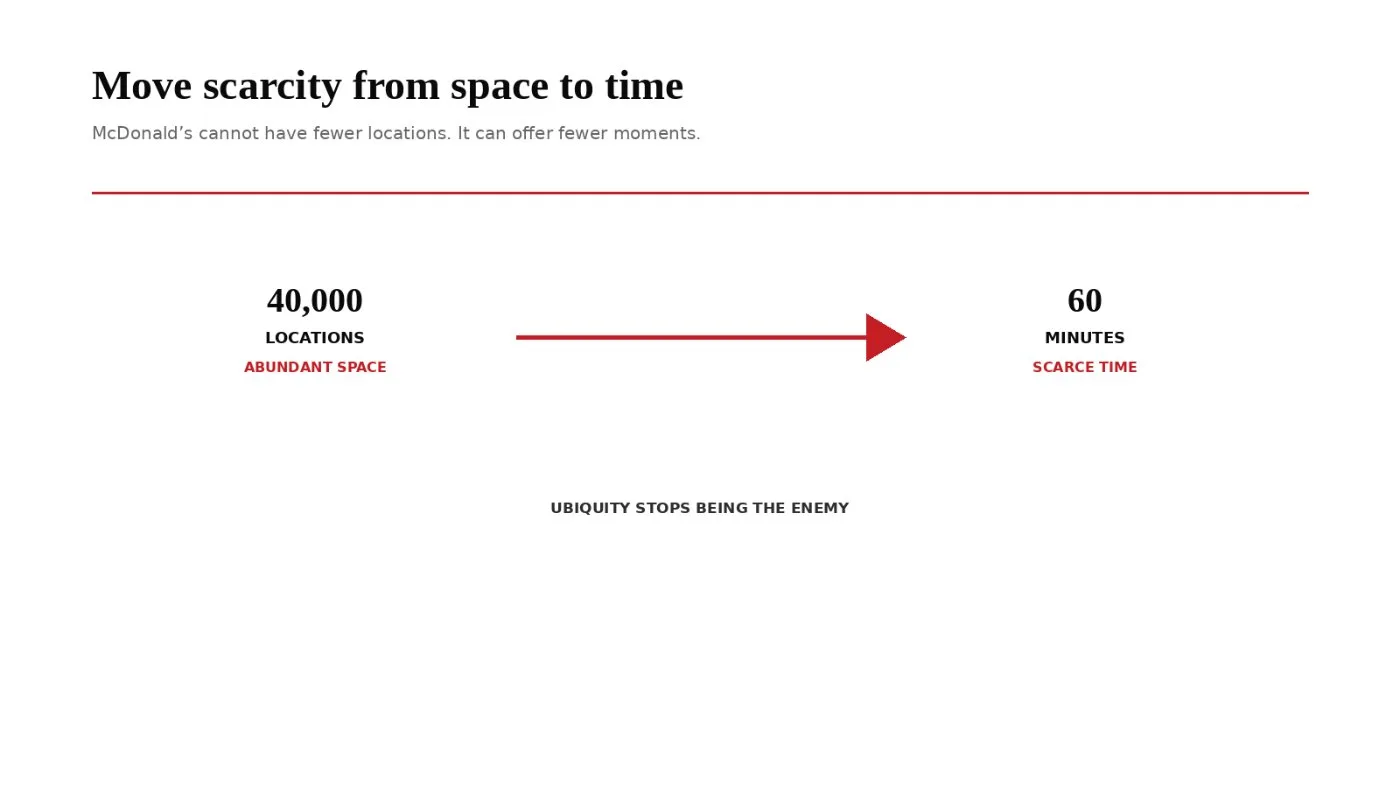
The only scarcity compatible with 40,000 locations is not spatial. It is temporal.
THE GOLDEN HOUR
How It Would Work in Practice
Let us bring it down to earth with a name, a time, and a product, because an idea you cannot touch is just a slogan. Let us call it The Golden Hour: every day, from 3:00 to 4:00 PM—the deadest window between lunch and dinner—at every location at the same time. One rule changes everything: during those 60 minutes, something exists that does not exist at any other hour of the day, and it cannot be ordered through the app or delivery. You have to be there. When the clock strikes 4:00 PM, it is over until tomorrow.
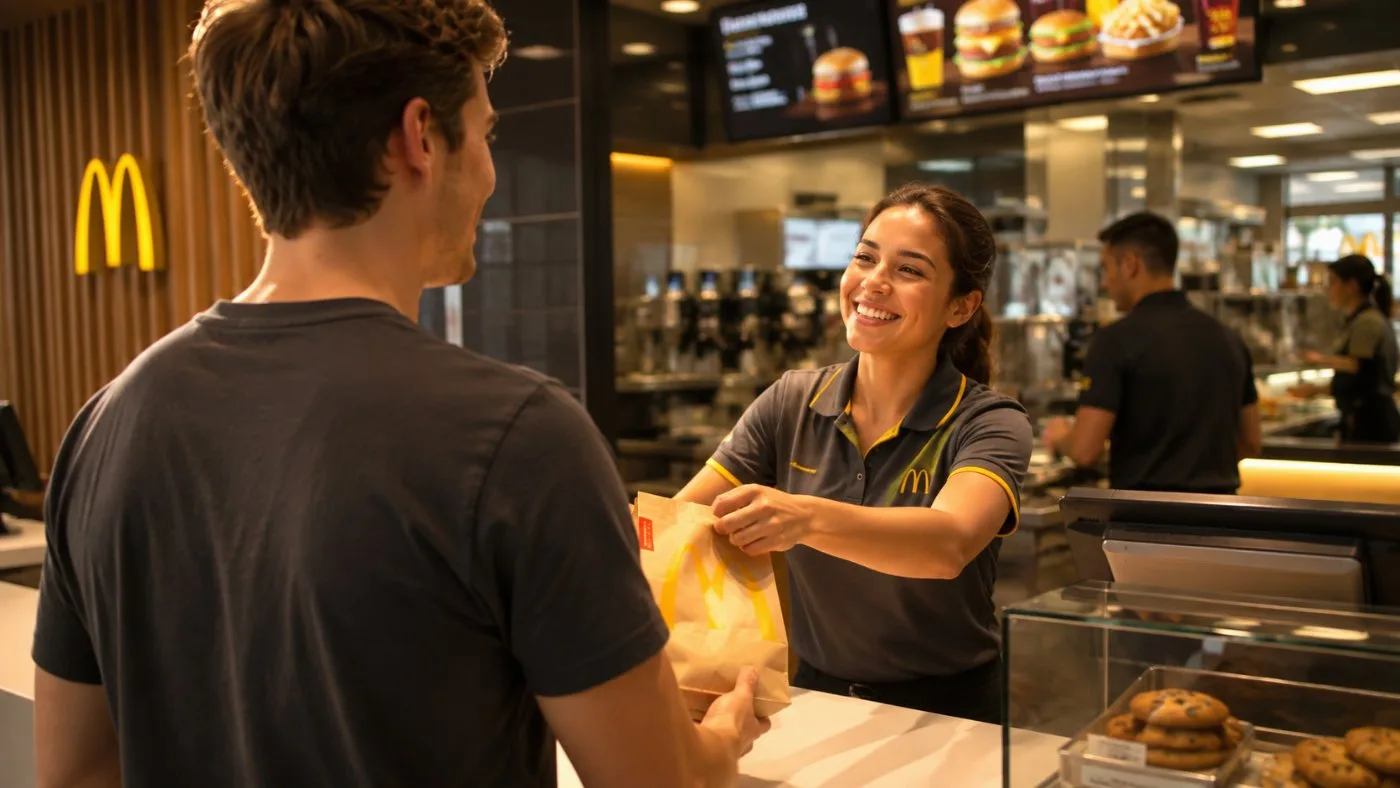
The opportunity must be in person and visible: being there is part of the value.
Concrete examples of what lives only in that hour:
01 Example 1 — The product that only exists at 3.
The “3 O’Clock Burger”: a recipe that is not on the menu at any other time, with a house sauce that rotates every week—one week smoked chimichurri, another spicy criolla sauce, another coffee barbecue. The regular never knows which one will be there until arriving: surprise is part of the hook. At 4:01 PM, that burger cannot be ordered even if you beg.
02 Example 2 — The flash price for the window.
The classic combo—burger, fries, and drink—at a price that runs only during those 60 minutes and is lower than any app discount, but only if you are physically inside the restaurant. The app might give you 15% at any hour; The Golden Hour gives you a better price, but only in person and only in that window. The discount stops being a permanent entitlement that devalues the brand and becomes a reward for being there.
03 Example 3 — The dessert that sells out.
A warm dessert baked only for that window, in a limited quantity at each location. When it sells out, it sells out—and people know it, so they arrive early. Scarcity inside scarcity: it is not only “only at this time,” but “only at this time and until it runs out.”
THE GOLDEN HOUR
The Clock Does the Work
Why this does create a permanent line instead of a one-off event: scarcity is daily and renewable, not a match that has to be relit. People know that every day at that time something happens that they cannot get at any other time, and that certainty creates the habit of being there. You do not depend on inventing a new launch every week or paying a celebrity: the clock does the work, free, every day, forever. It is self-sustaining by design. And because it happens at every location at once, ubiquity stops being the enemy and becomes the weapon: 40,000 simultaneous lines at the same hour is a phenomenon no chef-driven burger restaurant could even dream of, because it does not have the scale.
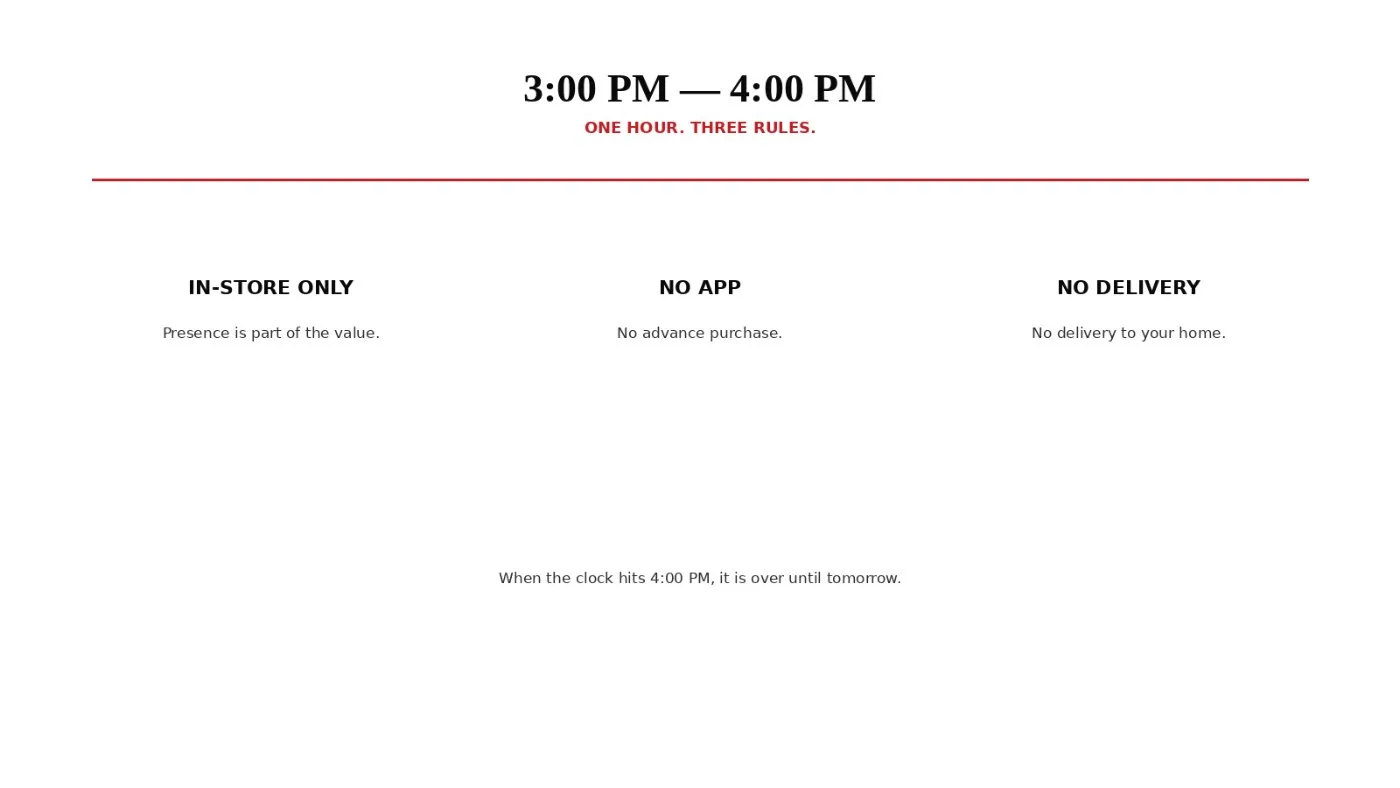
The time window turns physical presence into part of the experience.
“Forty thousand simultaneous lines at the same hour is a phenomenon no chef-driven burger restaurant could even dream of.”
UNLOCKING THE REGULAR
How It Would Work Step by Step
Here is the engine that turns someone who came once into someone who comes every day. The logic is this: the person who returns does not collect points to redeem—that rewards the person who spends the most. The person who returns unlocks access and status, things the occasional customer cannot buy with money. The concrete ladder:
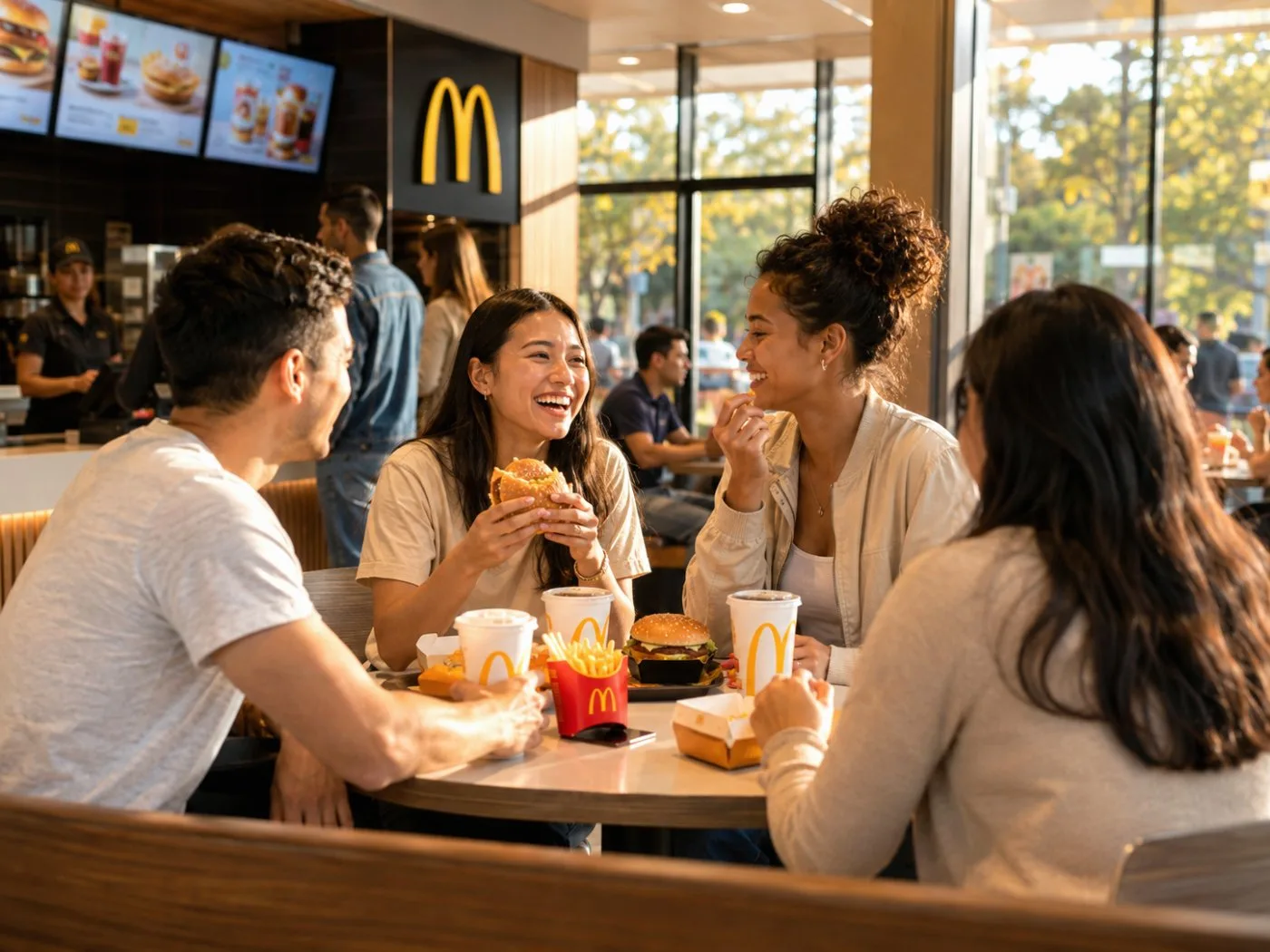
Repetition becomes social and visible when returning offers belonging, not just points.
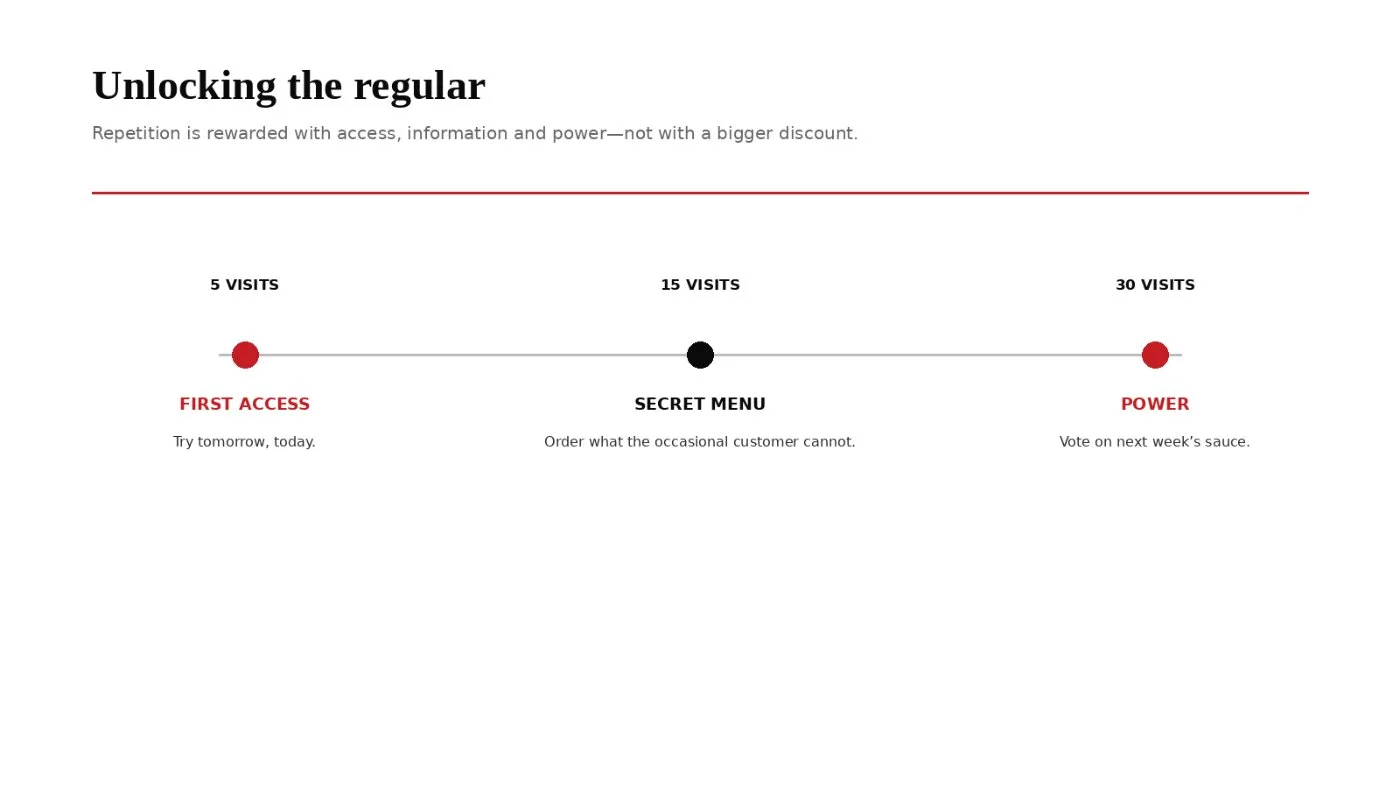
The ladder rewards recurrence with first access, a secret menu, and power.
THE REGULAR
Access and Status, Not Discounts
01 5 visits to The Golden Hour on different days
First access. You earn the right to try tomorrow’s 3 O’Clock Burger today, before anyone else. You know which sauce is coming tomorrow while everyone else still does not. Being first is a reward no discount can provide.
02 15 visits
The secret menu. A variation becomes available that appears nowhere and is known only by people from the time window: an extra topping, a “double” version of the sauce, an assembly that cannot be ordered unless you are a regular. Belonging becomes tangible: there is something you can order that the person next to you cannot.
03 30 visits
Power. Your name goes on the restaurant board that month and—most importantly—you vote on which sauce rotates in the following week. You stop being a customer and begin co-designing the product at your location. That customer no longer returns for the food: they return because the place is a little bit theirs.
Notice that none of the three rewards is money or a discount. They are access, privileged information, and decision-making power—things that cost almost nothing and that the occasional customer’s money cannot buy. That is what turns a single visit into a routine, and a routine multiplied by thousands is the line at three in the afternoon on an ordinary Tuesday.
How You Access It, and Why It Creates a Line Instead of Dispersing Demand
It cannot be reserved, it cannot be purchased in advance, it does not arrive at your home. You get it by being inside the restaurant during that hour. The very friction the industry is desperate to eliminate is what builds the line. And because it happens at a fixed, known time, people organize themselves to be there—just as they organize themselves not to miss something broadcast live. The dead window fills up because it is the only key to something you will no longer be able to have at four in the afternoon.
THE MOVE AGAINST THE ENTIRE INDUSTRY
Become Unavailable to Become Irresistible Again
The entire fast-food business was built around one sacred word: total availability. Everything, always, everywhere, at every hour. The heresy no executive dares to say is this: McDonald's has to become deliberately unavailable for 23 hours in order to become irresistible for one. Deny itself on purpose, every day. Let something good exist only inside one window and not exist during the rest of the day. It sounds insane for the brand of “always available.” But infinite availability is precisely what extinguished desire: when you can have something at any time, you want it at no time. The clock is the only thing McDonald's can make scarce without shrinking its empire. And people only run toward what they can lose.
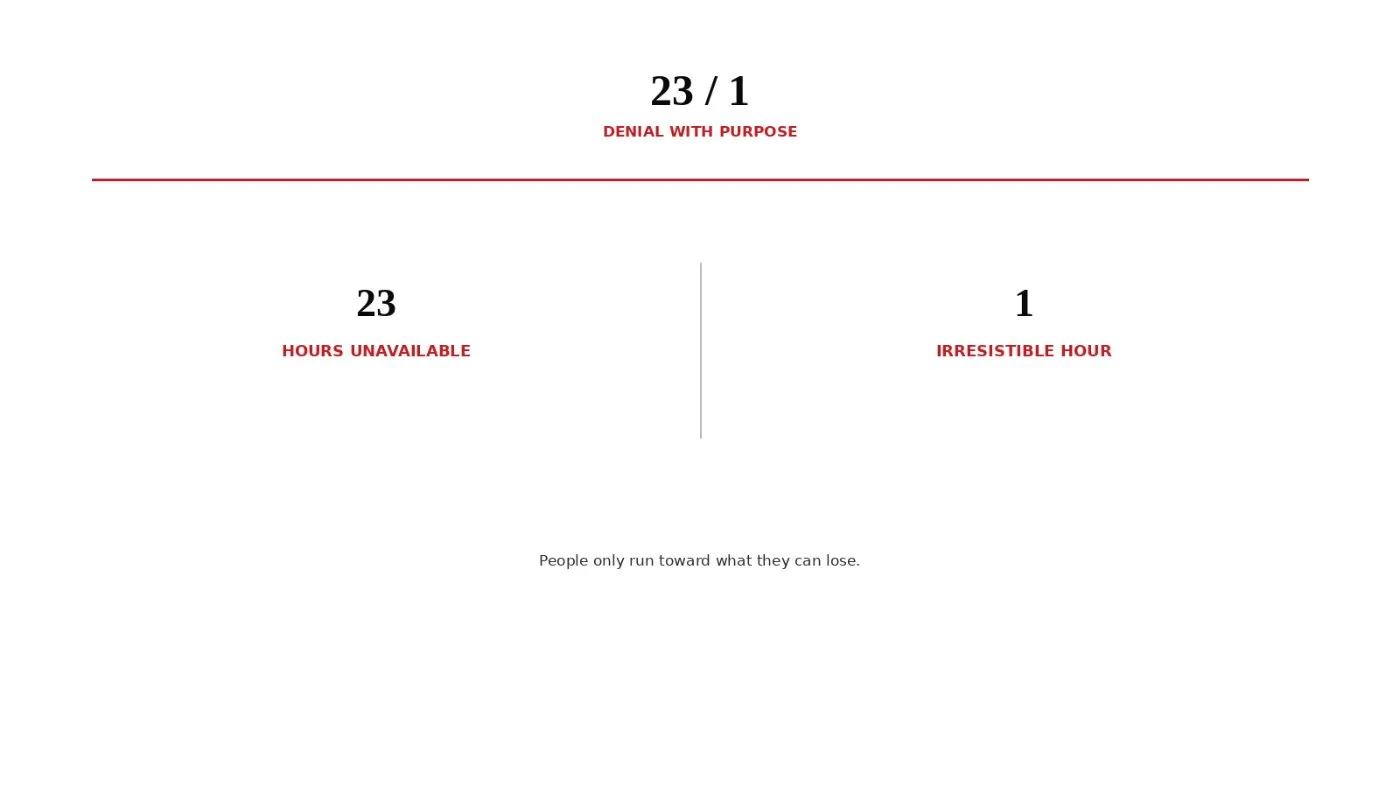
The strategic heresy: restrict one hour to restore desire during the rest of the day.
“When you can have something at any time, you want it at no time.”
THE FIRST MOVE
The First 90 Days
You do not launch this across 40,000 locations. You test it in one city, so the daily line becomes the proof.
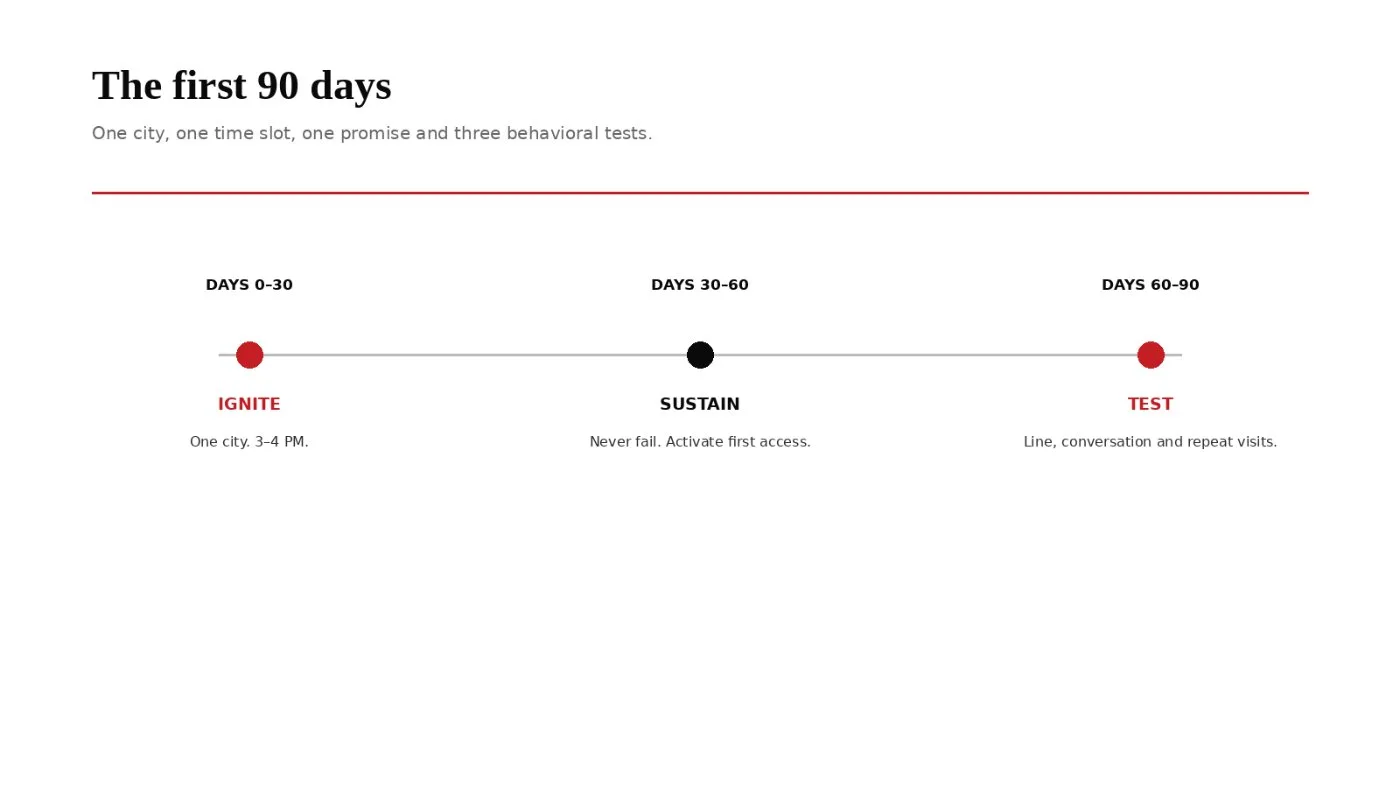
One city, one time window, one promise, and three behavioral tests.
Days 0–30
Choose one city and all its locations. Define a single window—from 3 to 4 PM—and start with one element of The Golden Hour: the 3 O’Clock Burger with a rotating sauce or the flash price, with a name and fixed time, without the app or delivery. Communicate it simply: every day, at this time, only inside. The goal for the month is not how much gets sold. It is for the first spontaneous line to appear at that hour on an ordinary day, with no event and no special promotion.
Days 30–60
Maintain the window every day without failing once—recurrence is the asset; one missed day breaks the habit. Turn on the regular unlock: activate first access after 5 visits so word begins to spread. The sign that it works: the 3 PM window has more people than lunchtime. When the dead hour beats the peak hour, the ritual has caught fire.
Days 60–90
Measure three things in order: there is a physical line at that hour every day, not once; the line has become a conversation—photos, videos, people talk about “the one at 3”; and who is in it. If the person who comes back to line up is the everyday young customer the brand had been losing, it worked, and it worked where it hurt. That is the story the press tells on its own: the most ubiquitous chain on the planet invented a sacred hour and once again had people waiting on the sidewalk every day, without paying a single celebrity.
THE VERDICT
Ubiquity Is Not Its Condemnation
McDonald's celebrates that the rich came in and regrets that the poor left, without seeing that both things say the same thing: the brand stopped meaning something and was reduced to a number in a display window. The rich customer saving it today will leave with the first improvement in the economy. The poor customer who left will not return for a discount, because they did not leave only because of money: it is exhausting when the only thing you can afford treats you as if cheap is all you deserve. The brand owns the most enviable asset on the planet—being everywhere, all the time—and it is spending it on being faster and cheaper, when that same asset, used in reverse, is the only thing capable of igniting thousands of lines at the same hour. Ubiquity is not its condemnation. It is the weapon it does not know it has.
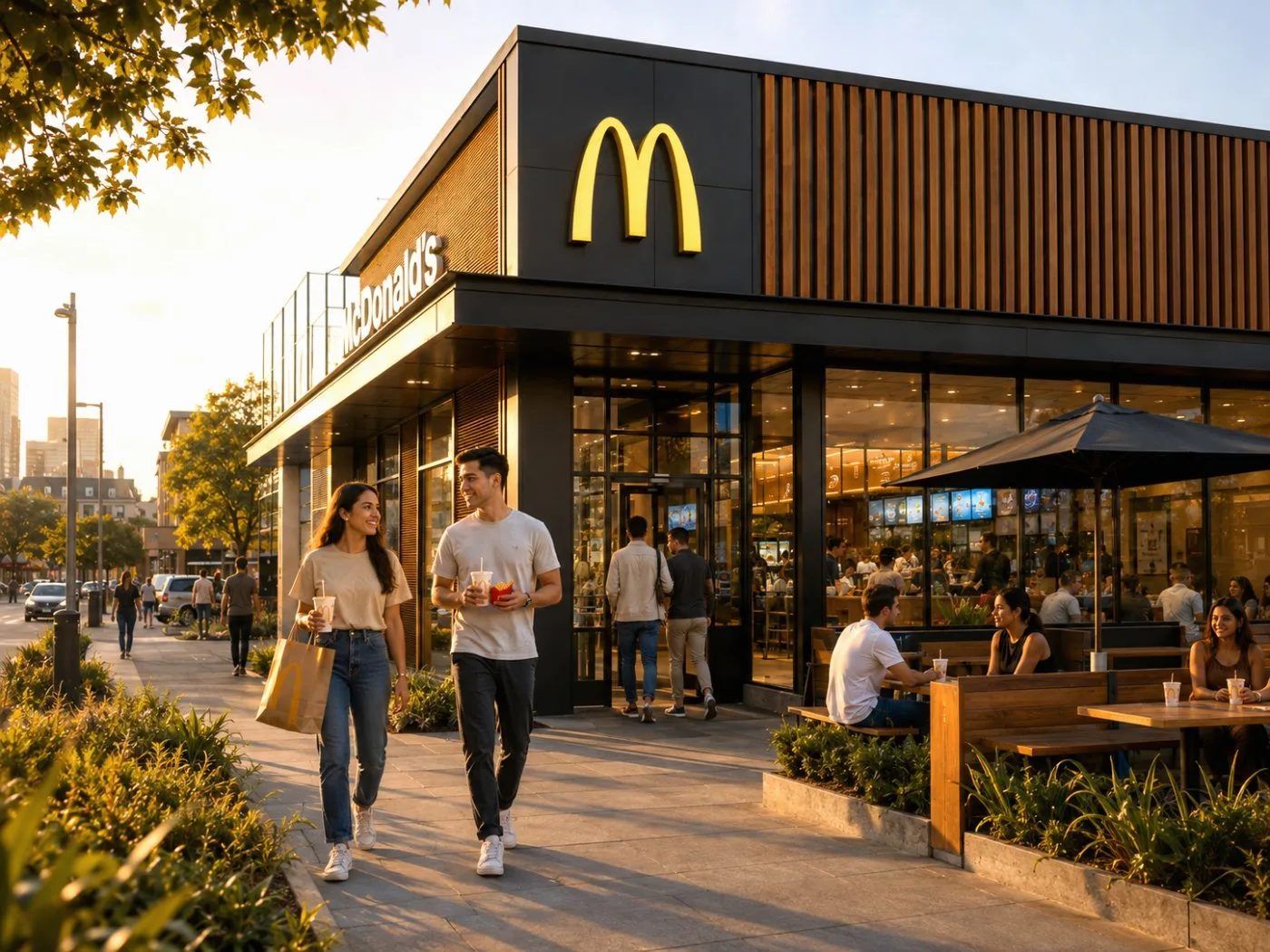
The same asset that dilutes desire today can concentrate it again: thousands of places, one single hour.
If your customer can have you at any time, anywhere, without effort, why would they line up for you? People do not stand on the sidewalk for what is abundant. They stand there for what they might lose. And sometimes the only way to make them desire you all day is to deny yourself for almost the entire day.
I design desire. I work with a limited number of organizations each year to preserve the depth and independence of the diagnosis.
LEGAL DISCLOSURE
Referential Use of Trademarks and Distinctive Elements
This document is an independent editorial and strategic analysis prepared for informational, illustrative, and brand-diagnostic purposes.
McDonald’s, its logos, trade names, trademarks, trade dress, packaging, product images, and all other distinctive signs belong to their respective owners. Every reference to those assets is used exclusively for identification, analysis, criticism, and illustration.
This report is not official McDonald’s material and does not imply sponsorship, affiliation, approval, or endorsement by McDonald’s Corporation, Arcos Dorados, its subsidiaries, franchisees, licensees, or representatives.
The conceptual images included were created to explain strategic hypotheses and potential customer experiences. They do not represent actual campaigns, products, promotions, prices, or initiatives of the company unless expressly stated.
The proposals contained in this report must be validated operationally, legally, regulatorily, and commercially before any implementation.
Prepared by Ariel Pfeffer
arielpfeffer@gmail.com · Life Rewards Action!
It is not about how much a combo costs. It is about what eating one means.
A brand that reflects no image of yourself can be replaced without feeling anything.
When you can have something at any time, you want it at no time.
The verdict
McDonald's stopped being “the place I want to go” and became “the place I settle for.”
What would an autopsy of your business say?
Every new autopsy reaches the list first: the short version, the key finding and a few extra things I don't publish anywhere. No spam, no discounts, no "last chance".
Get the autopsies before anyone else →