Autopsy Nº 01·Global
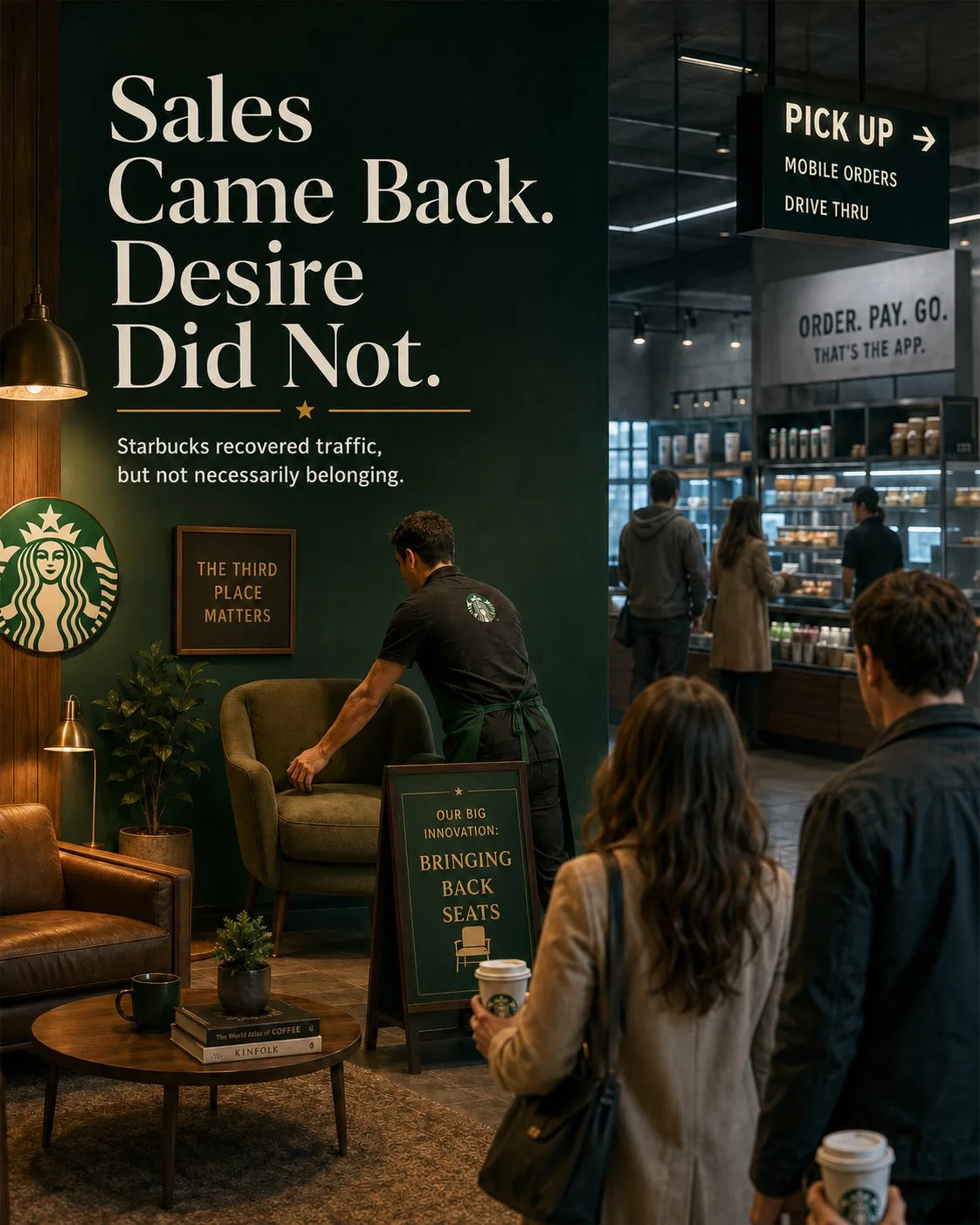
Sales Came Back. Desire Did Not
Starbucks Just Spent a Fortune Putting Back the Chairs It Removed
- BRAND ANALYZED:
- Starbucks
- Industry
- Coffee shops
- Country
- United States
- Published
- July 30, 2026
In five lines
Sales came back. Desire did not. Nobody went for the coffee: they went for the chair, for somewhere to be. Starbucks hollowed out exactly that —armchairs, warm light, your name written by hand— to squeeze margin, and pushed people to the window. The anger about eight dollars is not about the price: it is about everything that made the price make sense being taken away. The way out is not putting chairs back for everyone, but making the seat mean something again: earned by showing up, not by paying more.
Prepared by Ariel Pfeffer – arielpfeffer@gmail.com – Life Rewards Action!
I design desire. I work with a limited number of organizations each year to preserve the depth and independence of the diagnosis.
DESIRE AUTOPSY · An independent diagnosis of replaceability and desire
The brand revived sales. It still has not revived desire. And confusing those two things is the most expensive mistake a recovering business can make.
FactStarbucks announced that it will add 25,000 seats to its U.S. stores. Stop and think about that sentence. A company is celebrating as a strategic achievement the return of the chairs it removed three years ago. It is as if a restaurant invited you with great fanfare to discover its new idea: tables. The brand is selling this as the return of warmth and community, and the press is applauding because sales are rising again. And they truly are: the best quarter in two years, record sales of $9.53 billion, more people walking through the door. But the most interesting thing is what no one is saying out loud. Getting people to come back in is not the same as getting them to desire you again. Starbucks revived the body. It did not revive the soul. And a brand that confuses traffic with desire is using the money from its recovery to build its next decline. |
The cause of death
Let’s start with what people were really going there for, which was never coffee. For caffeine, the office machine is enough: it is free and does not make you wait in line. What Starbucks knew how to sell for twenty years was a place to be: neither your home nor your workplace, but a third place where you could sit with your computer, see people, exist for a while, and feel part of something vaguely aspirational. Coffee was the toll you paid for the chair. That was the real business, and it was a beautiful business, because no one else offered it.
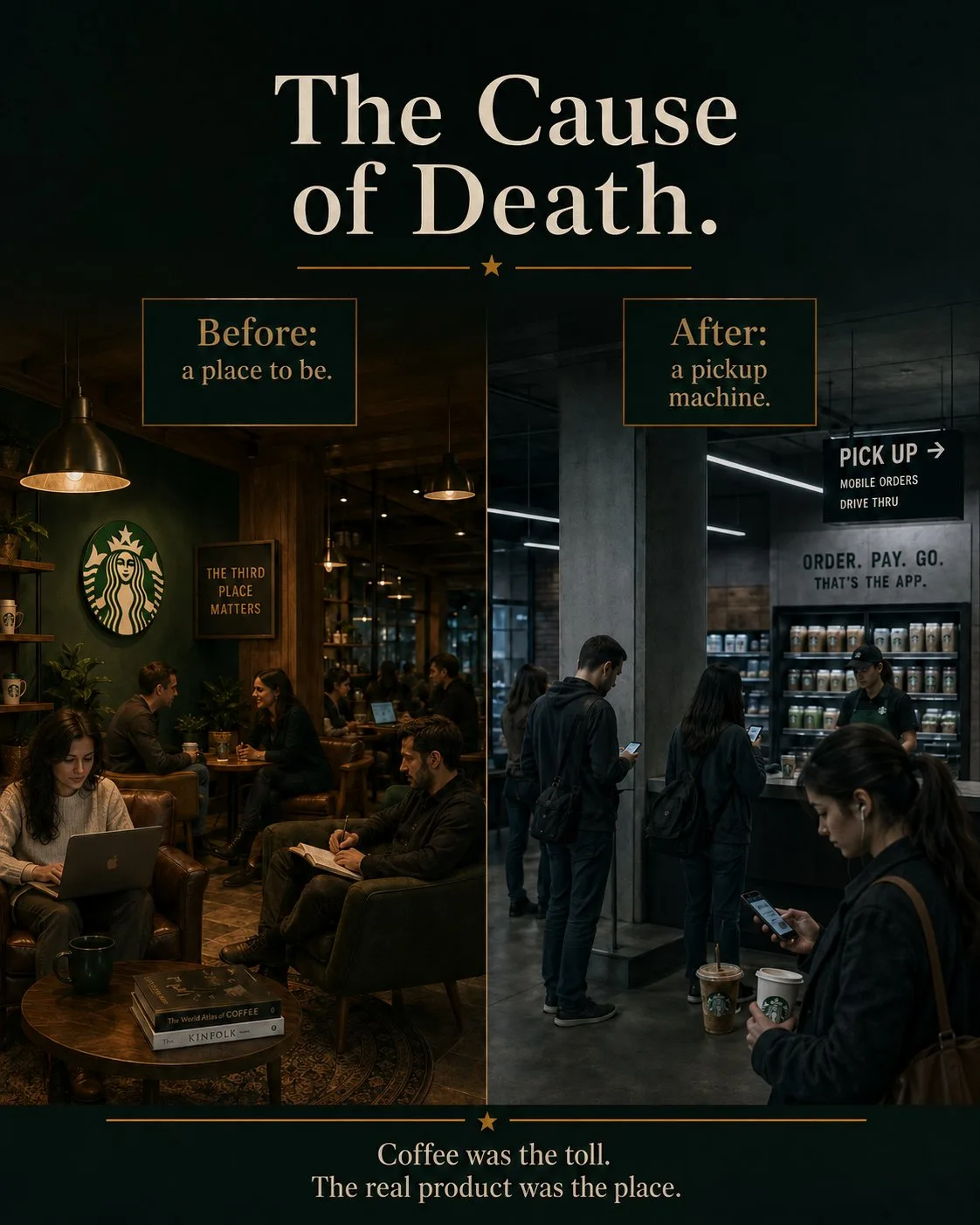
Then, in order to squeeze out more margin, the brand gradually hollowed out exactly that. It removed the armchairs and installed hard stools that invite you to leave. It replaced warm light with pharmacy lighting. It opened pickup-only stores without a single chair. It replaced your handwritten name with a machine-printed label. And it pushed the vast majority of its customers toward the app and the drive-thru—which is another way of saying it pushed them outside the only place that gave them a reason to come in. Today, three out of every four orders are cold beverages passed through a window, without anyone looking you in the eye. They turned a coffeehouse into a vending machine with good typography.
No one noticed in the first quarter. That is the trap of ruining something slowly: every chair you remove improves a number on a spreadsheet, and the customer does not complain; they simply come a little less often, a little more resigned, until one day they utter the sentence that kills brands without raising its voice: it’s not what it used to be. That is not a complaint. It is an emotional death certificate, signed by the customer.
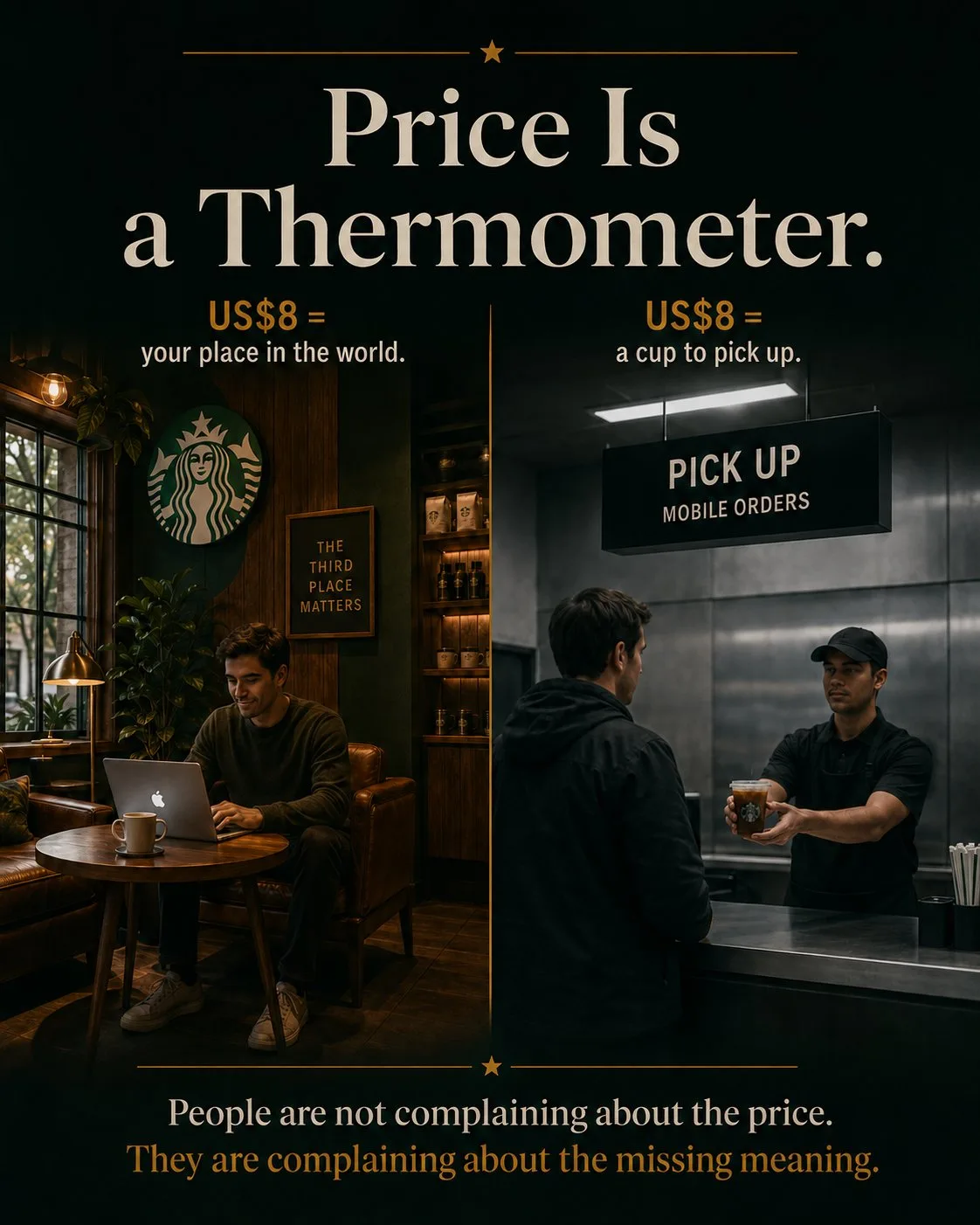
Now add the price, because the price here is not the problem; it is the thermometer. A grande latte costs five and a half dollars, and if you add plant-based milk and an extra shot, you are above eight. That figure is either a bargain or a rip-off depending on one thing: what you are buying. Eight dollars for an hour in your place in the world, with your table and someone who knows your name, is cheap. Eight dollars for a plastic cup you pick up from a counter while looking at your phone is outrageous. People who complain that Starbucks is expensive are not complaining about the price: they are complaining that everything that made the price make sense was taken away, leaving only the number. Anger about money is always, underneath it all, anger about missing meaning.
Meanwhile, the enemy appeared, although Starbucks has misidentified it. The company thinks its enemy is the fast drive-thru chain taking its breakfast business, or the specialty coffee shop on the corner, or the expensive coffee maker you bought during the pandemic. But those are symptoms. Starbucks’ real enemy is the indifference it manufactured with its own hands. Brands people love fight against something: some athletic-wear brands fight your laziness; some sodas fight your guilt. Starbucks fought urban loneliness, the condition of having nowhere to be in a city that is waiting for you nowhere. The day it removed the chairs, it surrendered in its own war. And a soldier who abandons the only battle it knew how to fight is not defeated by a rival; it becomes irrelevant all by itself.
The most revealing thing is what Starbucks did when it finally decided to react. It launched a three-tier loyalty program and gave the levels names that sound like bank cards: a basic tier, a middle tier, and a top tier that gives access to exclusive experiences, even a trip to Tokyo for ten selected members. It sounds good on a stage in front of investors. But look at what it did at a deeper level: it turned belonging into a points system. It makes you collect stars to earn a free coffee or enter a drawing for a trip, like an airline. That does not create desire; it creates points counters. A customer collecting stars does not love you; they are using you efficiently, which is the opposite of love. Starbucks still treats loyalty as a transaction with a reward, when real loyalty is an emotion with no receipt. The promise it left on the table—making customers feel part of something, feel seen, feel that they are in their place—is still there, untouched, waiting for someone to pick it up.
The resurrection: how to create lines
This is where the value lies, and where I need to be careful, because Starbucks has already begun moving toward belonging and premium experiences. Proposing “a membership with exclusive benefits” would mean arriving late to something it launched in March. We need to go precisely where Starbucks did not dare to go.
FactAnd that place is an idea that will give an executive at a 41,000-store chain hives: make the seat the reward, and make people earn it.
Consider the one thing Starbucks has that neither a fast drive-thru nor your home coffee maker can ever replicate. It is not the coffee; anyone can match the coffee. It is the place. The physical square footage where you are. Starbucks owns the scarcest asset in modern urban life—a place to sit that is neither your home nor your office—and it is giving it away or, worse, denying it through uncomfortable stools. The move is to stop treating space as a cost that must be turned over and start treating it as the privilege it is.
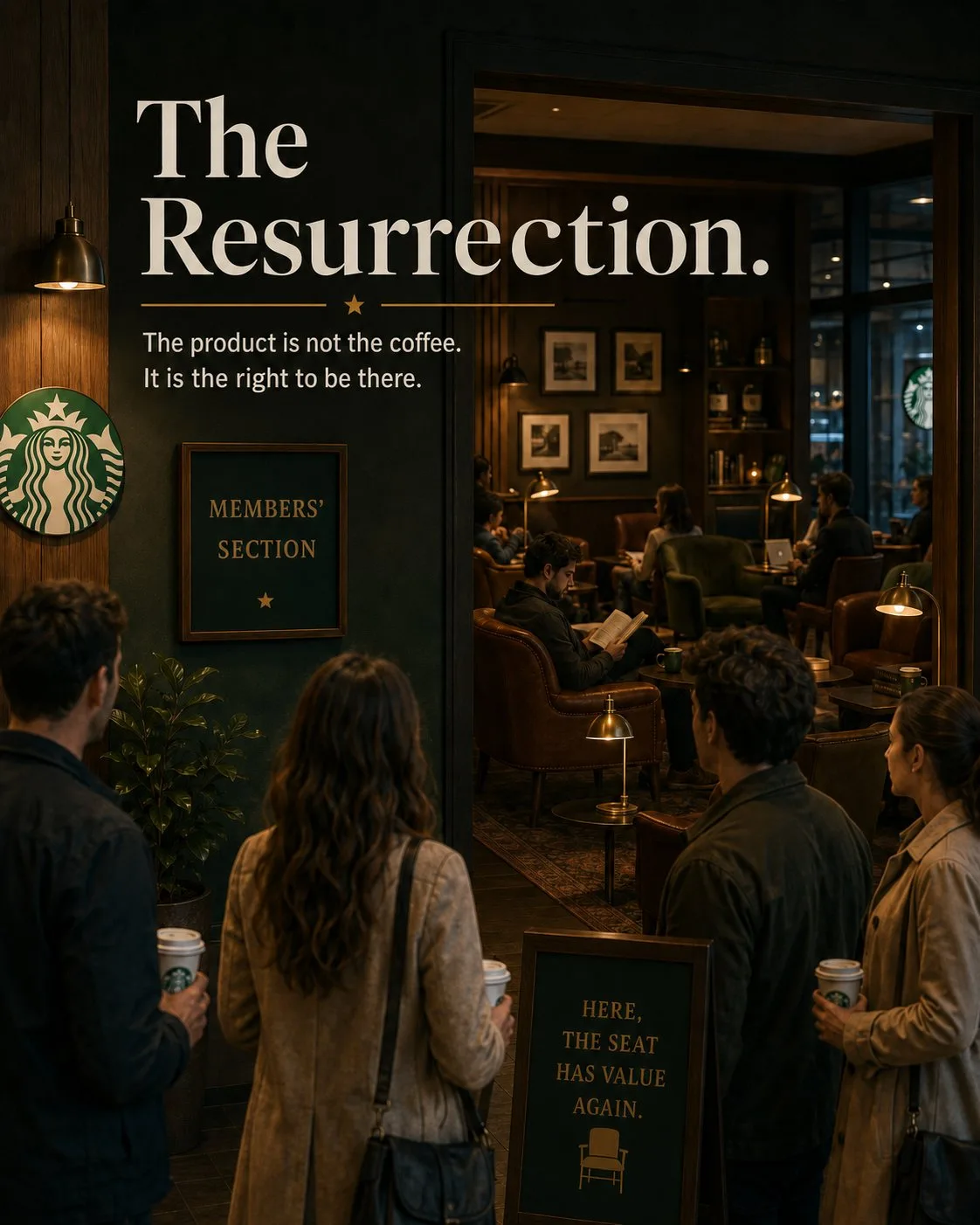
Imagine this. In every store, part of the seating area—the best part, with real armchairs, power outlets, beautiful lighting, and quiet—is no longer available to anyone who walked in to pick up a Frappuccino. That section belongs to those who belong. Not to those who collected the most stars by buying more coffee—that rewards the biggest spender, which is what Starbucks already does. It belongs to those the brand chooses and to those who choose the brand in a way that goes beyond money.
How access works
Here is the most important design decision, the one that turns everything upside down: you do not gain access by paying more. You gain access by showing up.
If the seat can be bought, it is just another premium service, and the brand becomes the company that charges rich people to sit down. Ugly—and easy for anyone to copy. But if the seat is earned through presence, something different happens: the privilege rewards not the person with money, but the person who chose this place. That is belonging, not business class.
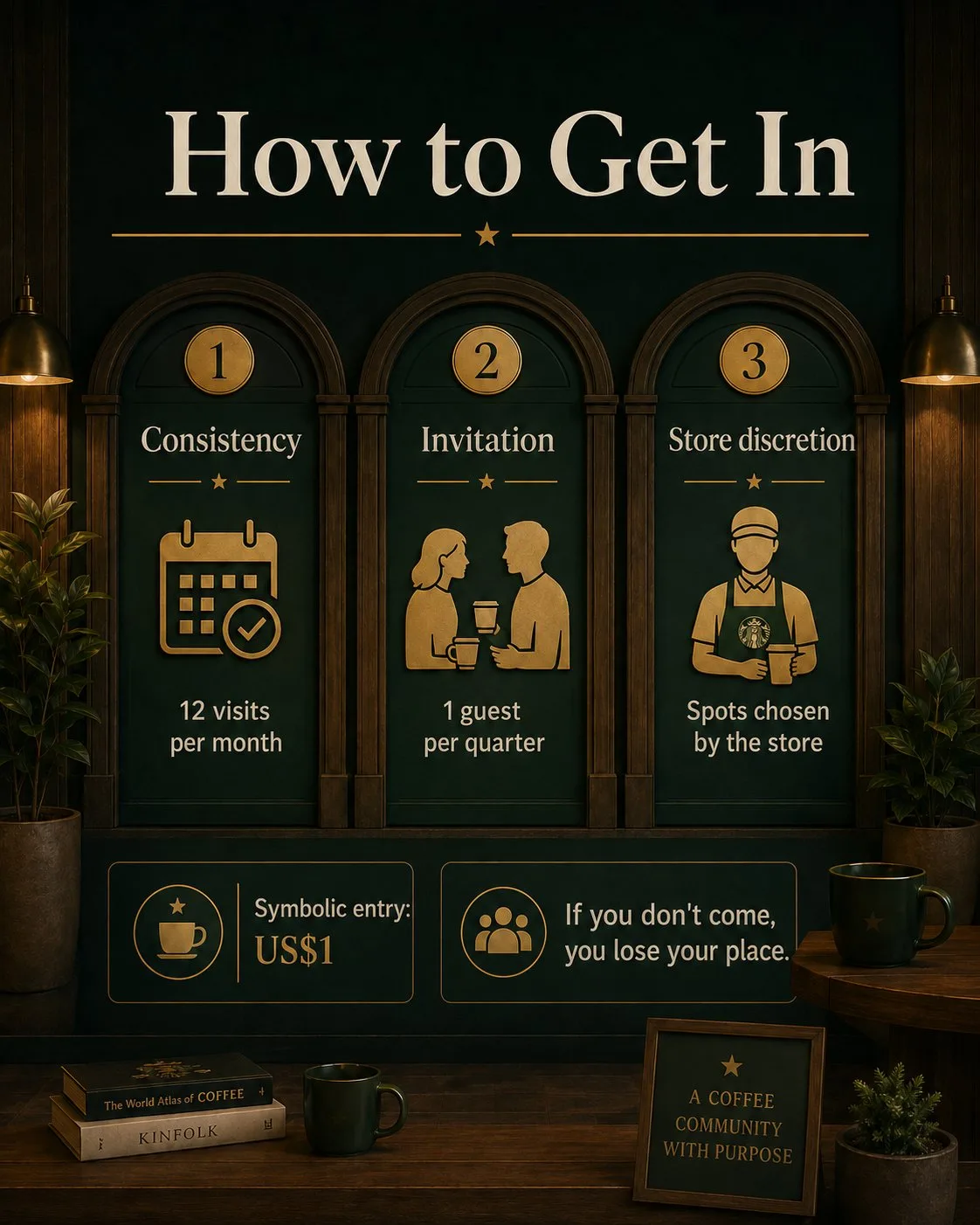
The mechanics have three doors. The main door is consistency: twelve visits in one month qualify you. Not twelve expensive coffees—twelve times crossing the threshold. A simple espresso counts the same as a grande Frappuccino, and that equality is deliberate: the student who comes every day and orders the cheapest item on the menu is worth more to this system than the executive who spends three times as much once a week. The first is a neighbor; the second is a passenger. The brand needs neighbors. The side door is invitation: each active member may nominate one person per quarter. Just one. That turns members into organic recruiters and adds the one ingredient no points program has: someone chose you. The narrow door is store discretion: a small percentage of seats is left to the manager, for the longtime regular the machine fails to detect, the retiree who has come every morning since before the app existed. It gives decision-making power back to the person serving customers—the very power that was taken away when that person was turned into a cup dispatcher.
And the part that holds it all together: membership can be lost. If you do not meet the minimum number of visits in a month, you are out, and your place goes to the first person on the waiting list. It is not punishment; it is what keeps the system alive. A privilege that cannot be lost stops being a privilege after six months.
What it costs
Before the numbers, an honest warning: what follows is a design hypothesis, calibrated against what is known about the business, not market data. The real price comes from testing, not from a document.
The membership does not carry a monthly fee. That sounds like leaving money on the table, so here is the reasoning. If you charge a monthly fee, this becomes a subscription, and subscriptions are evaluated coldly: people calculate how much they used them and cancel. Worse, those who pay feel entitled to make demands, and those who do not pay feel excluded by money. The entire emotional effect evaporates.
What is charged is a symbolic entry fee: one dollar, once, when the membership is activated. One dollar is not a business model; it is a threshold. It makes the gesture deliberate, creates a record, and ensures this is not an unvalued gift. What matters is not the dollar; it is the exact second when someone stops being a customer who goes to Starbucks and becomes someone who has their place at Starbucks. That identity shift is what sustains frequency for years. Charging one hundred dollars would not buy that shift; one well-placed dollar would.
FactSo where does the money come from? From what we already know: members of the current program spend considerably more than nonmembers, and that club already accounts for nearly 60% of U.S. sales. If a member goes from three weekly visits to five, with a six- or seven-dollar ticket, that is about fifty additional dollars per month from that person alone. Multiply that by two hundred members at one store, and it is a serious number. The business is not in charging for membership. It is in the frequency membership creates. Charging admission would be like charging people to stand in the line you want them to form.
What members receive, specifically
Five things, none of them a discount. The stars program already offers discounts, and they did not create love.
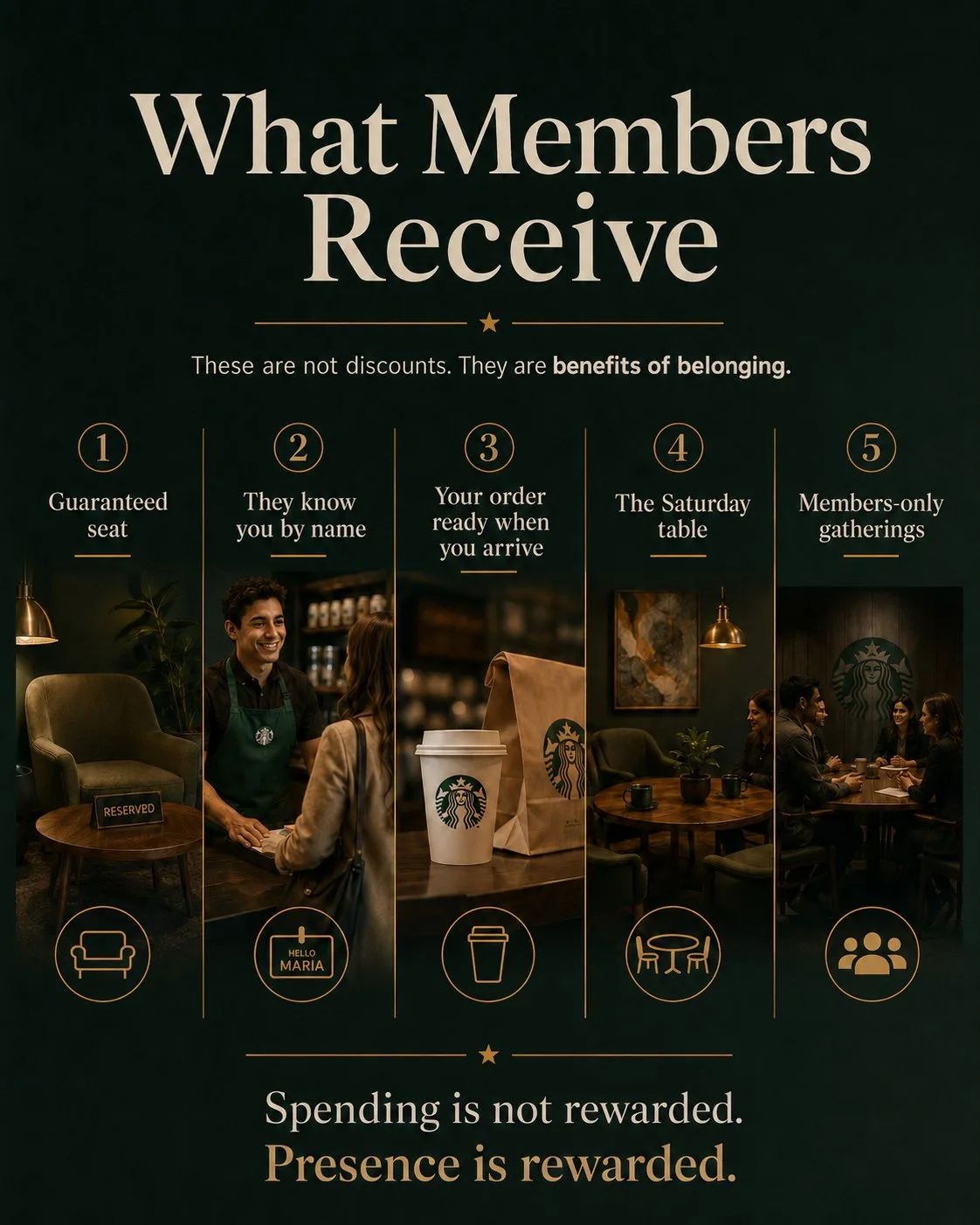
A guaranteed seat. The good section—real armchairs, power outlets, good light—belongs to members during peak hours. Outside those hours, it belongs to everyone. There is no rope or velvet cord: there is discreet signage and a manager who keeps things in order. What presence earns is not a piece of furniture; it is the certainty of having somewhere to sit when it matters most.
Being known. The staff has your photo, name, and usual order in the system, and is trained and evaluated on this. You walk in and someone says your name before you do. It sounds minor. It is not: it is exactly what the brand destroyed when it replaced the person writing your name on the cup with a label printer. Restoring that for two hundred people per store is infinitely cheaper than pretending to do it for forty million.
Your order ready when you arrive. The member signals that they are on the way, and their coffee comes out when they walk through the door, not when they reach the end of the line. No app in the middle, no drive-thru: the convenience that now forces you out of the store is put to work helping you stay inside.
The Saturday table. A member can reserve a table once a week for two hours—to work, hold a meeting, or do whatever they want. Reserving a table at Starbucks is unthinkable today, and that is exactly the point: the unthinkable is what people talk about.
Members-only gatherings. Once a month, after hours, the store opens only for members: a tasting of the new origin, or the seasonal launch the night before it reaches the public. Not a trip to Tokyo for ten drawing winners—that is a raffle, and almost no one gets it. Something small that happens to the two hundred people in your neighborhood, every month. Belonging is built through local repetition, not a distant prize.
The proof that the design is right: none of the five benefits costs meaningful money. They cost attention, training, and decision-making. Everything required is already inside the store—the chairs, staff, coffee, and space—and today it is being misused. Nothing needs to be built. Starbucks just needs to stop treating the customer like traffic.
Why this creates a line and the points program does not
Because human beings do not stand in line for a discount—they seek it out, compare it, and use it dispassionately—but they will stand in line to belong to something not everyone can have. Look at the entrance to any desirable place in the world: people wait outside not despite the difficulty of getting in, but because it is difficult. The barrier does not repel; it attracts. A legendary nightclub does not fill its entrance by lowering the admission price; it fills it by making entry mean something. Starbucks has 41,000 doors and left every one wide open so anyone can pass through as quickly as possible. It made universal access its strategy, and universal access is exactly what killed desire.
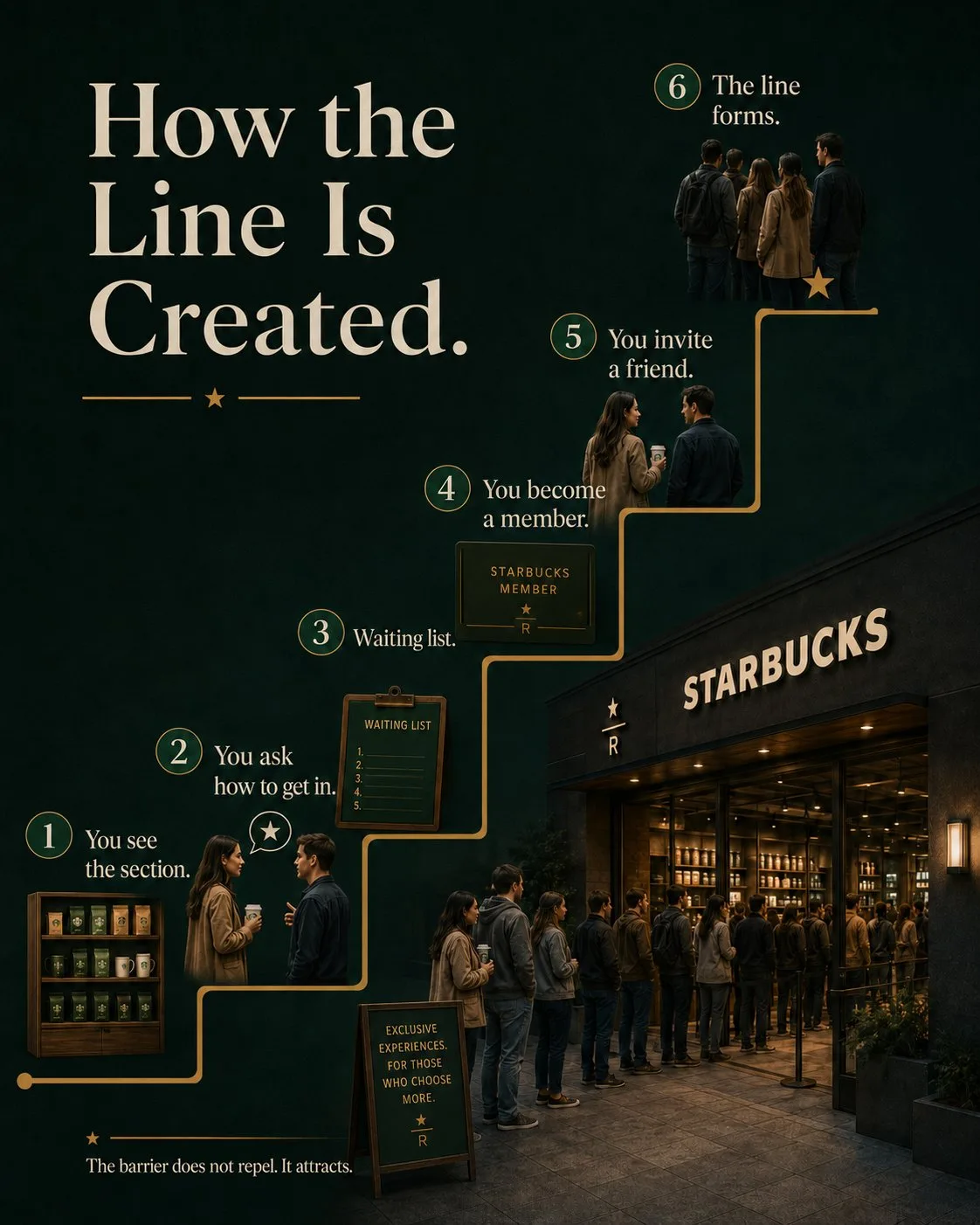
That is how the full ladder is built, from the smallest initial gesture to a real line. You see someone sitting in the members’ section, with their coffee and their place, while you wait standing with your cup: positive envy and curiosity are born. You ask how to get in and are told there is a list, that your neighborhood is full. “It’s full” does more for desire than any campaign. You cross the threshold with a minimal gesture—the dollar—and your identity changes: from customer to member. Then you bring a friend to show them your place, and the brand has just turned a customer into a salesperson. The friend joins the waiting list. The line is not a metaphor here. It is literal.
What removes the fear of entering is a clean exit: try it with no ties, leave whenever you want, with no fine print. A narrow door is seductive only if the promise is kept inside; if those who enter are disappointed, scarcity backfires. Restriction forces Starbucks to be excellent inside, which is precisely the discipline it lost when it opened the door to everyone.
The idea that goes against the entire industry
The entire retail industry prays for one thing: more traffic, more people, more turnover—get the customer out quickly to bring in the next one. Starbucks’ entire operation is optimized for that today. The uncomfortable truth no one in that industry wants to hear is this: in a world where absolutely everything is instant and available to everyone, scarcity has once again become the only thing people desire. Unlimited access is not an asset; it is what diluted the brand until it became water.
So the most profitable long-term move is the most counterintuitive of all: Starbucks should deliberately close off part of its space. Not all of it. The best part, for those who belong. It sounds insane for a volume-selling machine. But the more mass-market and commoditized coffee becomes outside, the more valuable it is to have inside the one thing that cannot be copied: a place that is yours, in a city that saves a place for you nowhere else.
The first move: the first 90 days
None of this launches in 41,000 stores. It launches with an appetite for scarcity, in a few places, so that the waiting list does the marketing on its own.
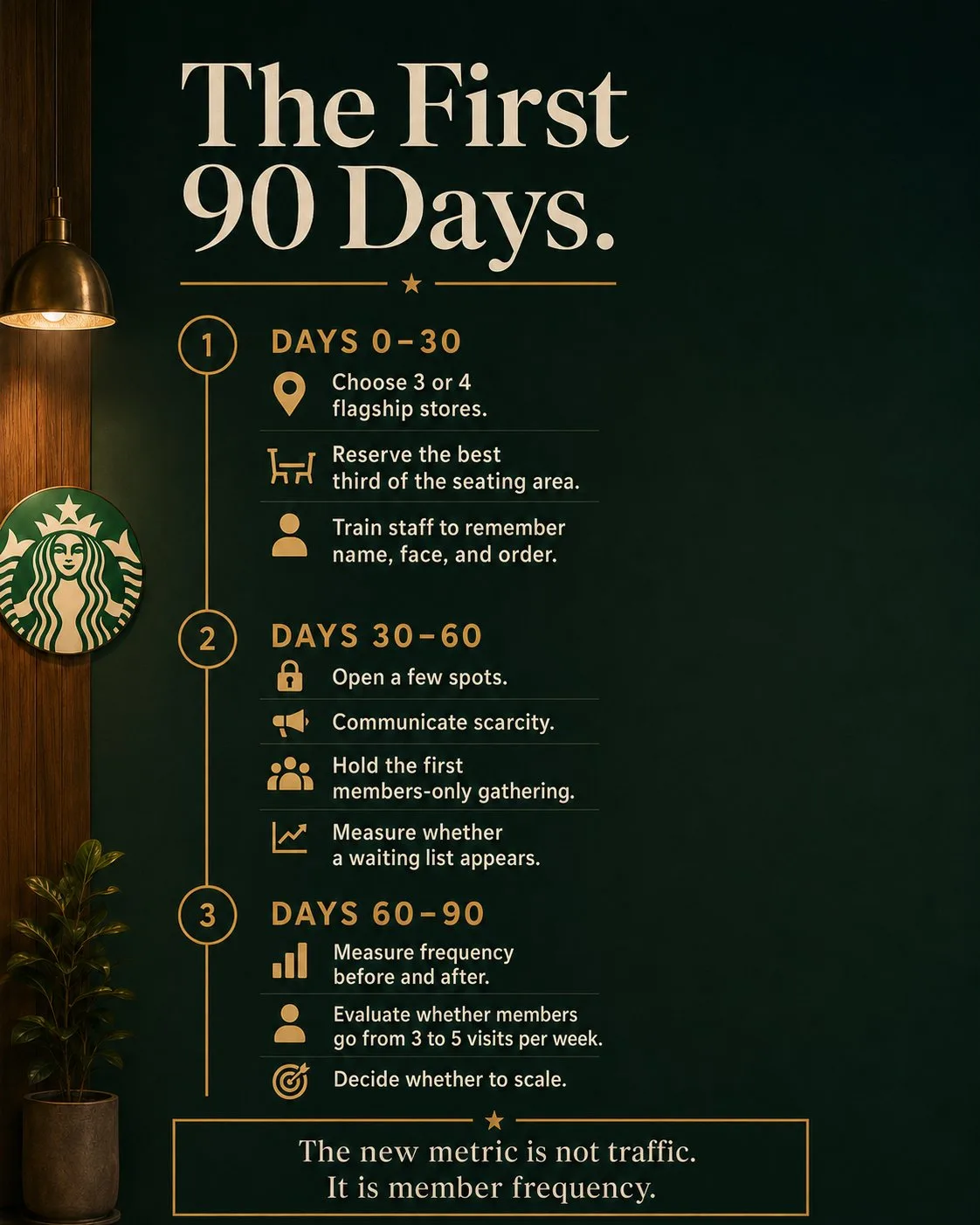
Days 0–30. Select three or four flagship stores where people already stay for hours, and turn the best third of the seating area into the members’ section. Train the staff in the one thing it does not do today: memorize the first members. Name, face, order, something personal. The month’s goal is simple: by a member’s second visit, everyone behind the bar should recognize most members by name. That was impossible when the directive was to move orders fast; with narrow doors, it is possible.
Days 30–60. Open a small, public number of places per store. Few, deliberately. Communicate it for what it is—limited spots, not for everyone—and let the restriction speak. Hold the first members-only gathering at each store. There is one sign that it works: more people want to enter than there are places available. If there is no waiting list, something is wrong with the proposition, and it should be corrected before growing, not afterward.
Days 60–90. Measure the only thing that truly matters: whether members visit more often than before becoming members. Not how many people came in overall—that is the old volume metric. The new metric is each member’s frequency against their own history. If someone went from three visits per week to five, belonging worked. That is the number to take to the decision table, and it is the number that—if sustained—turns all this into a story the press tells on its own: the giant chain that stopped begging for traffic and formed a line by making entry worth something.
The verdict
Starbucks spent twenty years teaching the world that a coffee could be a place, and the last five teaching it that it could also be a drive-thru window. Now that sales have returned, it faces the most subtle risk of all: believing the problem is solved because the customer walked back in. It is not. The customer returned out of habit and for good coffee, not desire, and habit is borrowed: someone faster or cheaper comes along and takes it. Desire is not. The company is spending a fortune replacing chairs to recreate the warmth it erased, when the move is not to give everyone more seats; it is to make the seat mean something again. No one stands in line for a window. People stand in line for a place where they are expected.
And the question is not only for Starbucks. It applies to anyone with a business reading this: are you charging your customer for a product, or for the right to belong to something? People bargain over the first. For the second, they line up at the door.
I design desire. I work with a limited number of organizations each year to preserve the depth and independence of the diagnosis. |
They turned a coffeehouse into a vending machine with good typography.
A customer collecting stars does not love you; they are using you efficiently, which is the opposite of love.
Anger about money is always, underneath it all, anger about missing meaning.
The verdict
The customer returned out of habit and for good coffee, not desire, and habit is borrowed: someone faster or cheaper comes along and takes it.
What would an autopsy of your business say?
Every new autopsy reaches the list first: the short version, the key finding and a few extra things I don't publish anywhere. No spam, no discounts, no "last chance".
Get the autopsies before anyone else →